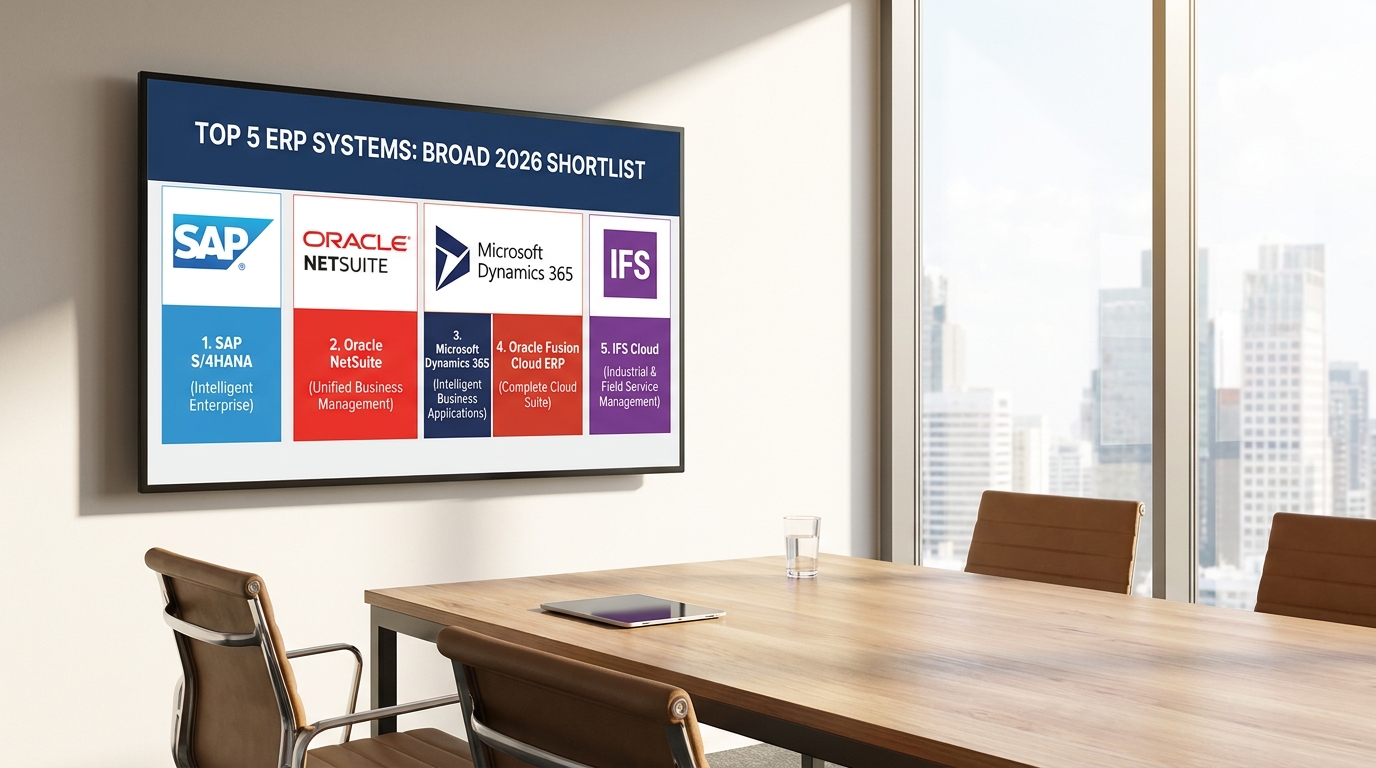
What are the top 5 ERP systems? The answer depends on the size of the organization, industry, business processes, implementation requirements, and whether the company needs a general-purpose enterprise resource planning platform or an ERP designed specifically for construction.
Thank you for reading this post, don't forget to subscribe!Thank you for reading this post, don't forget to subscribe!For a broad 2026 ERP shortlist, SAP S/4HANA, Oracle NetSuite, Microsoft Dynamics 365, Oracle Fusion Cloud ERP, and IFS Cloud are five of the most important ERP systems to evaluate. For construction companies, however, specialized platforms such as CMiC, Trimble Viewpoint, Acumatica Construction Edition, Sage Intacct Construction, and other construction-focused solutions may be a better operational fit.
There is no universally accepted “best ERP.” Independent 2026 ERP research places SAP S/4HANA, Oracle NetSuite, and Microsoft Dynamics 365 among the leading systems, while construction-specific research adds platforms such as IFS Cloud, CMiC, Trimble Viewpoint, Acumatica Construction, and Sage Intacct Construction because construction companies have specialized requirements such as job costing, project accounting, subcontractor management, retainage, and progress billing.
This distinction is especially important for contractors. A powerful general ERP may be excellent for finance and supply chain management but still require construction-specific configuration, integrations, or partner applications.
Quick Answer: What Are the Top 5 ERP Systems?
| ERP system | Best suited for | Key strengths | Construction relevance |
|---|---|---|---|
| SAP S/4HANA | Large and multinational organizations | Finance, procurement, supply chain, project management, global operations | Strong enterprise construction and engineering capabilities |
| Oracle NetSuite | Growing and mid-market businesses | Cloud financials, accounting, procurement, inventory, reporting | Useful for growing project-based businesses; construction functionality may require configuration or partners |
| Microsoft Dynamics 365 | Organizations using the Microsoft ecosystem | Finance, operations, CRM, analytics, Power Platform integration | Construction capabilities can be extended through industry-specific solutions |
| Oracle Fusion Cloud ERP | Large and complex enterprises | Financial management, procurement, project management, enterprise controls | Strong option when combined with Oracle's construction and project applications |
| IFS Cloud | Project-driven, asset-intensive organizations | ERP, asset management, field service, project management | Strong fit for construction, engineering, infrastructure, energy, and asset-intensive projects |
This is a shortlist rather than a universal ranking. ERP suitability depends heavily on company size, industry, project complexity, geographic requirements, existing systems, and implementation strategy.
What Is an ERP System?
ERP stands for Enterprise Resource Planning. An ERP system connects important business functions through a shared technology platform and database.
Depending on the product, an ERP can manage:
- Accounting and financial management
- Accounts payable and receivable
- Purchasing and procurement
- Inventory
- Human resources
- Payroll
- Project management
- Job costing
- Customer relationship management
- Supply chain management
- Asset management
- Business intelligence and reporting
- Project forecasting
For construction companies, ERP software can provide a central connection between project operations and financial management.
Why Construction Companies Need a Different ERP Evaluation
A construction company does not operate like a typical office-based business.
Contractors may need to track costs by project, phase, cost code, employee, subcontractor, equipment, and material. They may also deal with change orders, retainage, progress billing, commitments, subcontract compliance, multiple jobsites, and complex project schedules.
Construction ERP research specifically highlights job costing, AIA progress billing, retainage, and subcontractor compliance as important capabilities when evaluating ERP systems for construction and real estate.
That is why the most famous ERP in the general business market is not necessarily the best ERP for a contractor.
For a deeper construction-specific comparison, see our guide to What Is the Best ERP for Construction?.
1. SAP S/4HANA
SAP S/4HANA is one of the leading enterprise ERP platforms for large and complex organizations.
It is designed to connect financial management, procurement, supply chain, project operations, asset management, and other enterprise processes.
SAP also maintains dedicated solutions for the construction and real-estate industry. Its construction offering emphasizes connecting field data with finance, project delivery, procurement, compliance, and business intelligence.
Key SAP S/4HANA Capabilities
- Financial management
- Procurement
- Supply chain management
- Project management
- Project financials
- Asset management
- Enterprise reporting
- Multi-company and global operations
- Construction and engineering processes
- Cloud ERP capabilities
SAP's Engineering, Construction & Operations functionality specifically covers construction and plant engineering processes, including bills of services and equipment and tools management.
Who Should Consider SAP S/4HANA?
SAP is generally more appropriate for large organizations that need deep enterprise controls, multiple business entities, complex procurement, global operations, and extensive financial and operational integration.
For a small contractor with a handful of employees, SAP may be unnecessarily complex. For a multinational construction, engineering, infrastructure, or EPC organization, its enterprise capabilities can be much more relevant.
2. Oracle NetSuite
Oracle NetSuite is a cloud ERP platform commonly considered by growing and mid-market businesses that want to consolidate financial and operational processes in one system.
NetSuite is particularly associated with cloud financial management, accounting, procurement, inventory, reporting, and business management.
Current 2026 ERP research identifies NetSuite as one of the leading options for fast-growing mid-market companies looking for unified cloud ERP. Construction-specific research also places Oracle NetSuite among the leading construction and real-estate ERP options, although specialized construction requirements may require configuration or additional solutions.
Key NetSuite Capabilities
- Financial management
- Accounting
- Procurement
- Inventory management
- Order management
- Project management
- Revenue management
- Business intelligence
- Multi-entity management
- Cloud-based reporting
Who Should Consider NetSuite?
NetSuite can be attractive to growing businesses that want a cloud-first ERP without building and maintaining a large on-premise enterprise infrastructure.
Construction companies should carefully verify support for construction-specific requirements such as job costing, retainage, progress billing, subcontractor workflows, and project financial controls before selecting NetSuite.
3. Microsoft Dynamics 365
Microsoft Dynamics 365 is an ERP and business-application ecosystem that combines finance and operations capabilities with Microsoft's broader technology stack.
One of its biggest advantages is the ability to connect ERP processes with Microsoft products, analytics, automation, collaboration, CRM, and the Power Platform.
Current construction ERP research identifies Microsoft Dynamics 365 as a major option for mid-market and enterprise organizations, with construction functionality often extended through industry-specific ISV solutions and partners.
Key Dynamics 365 Capabilities
- Financial management
- Project accounting
- Procurement
- Supply chain management
- Resource management
- Customer relationship management
- Business intelligence
- Workflow automation
- Power Platform integration
- Construction industry extensions
Who Should Consider Microsoft Dynamics 365?
Dynamics 365 can be particularly attractive to organizations already invested in Microsoft technology.
For construction companies, the platform's flexibility can be an advantage because industry-specific partners can extend the core ERP with construction workflows.
However, this also means buyers should evaluate the complete solution rather than judging Dynamics 365 solely on its core ERP modules.
4. Oracle Fusion Cloud ERP
Oracle Fusion Cloud ERP is designed for organizations that need enterprise-level financial management, procurement, project management, reporting, and operational controls.
Oracle's broader construction technology ecosystem can also connect ERP with project scheduling, document management, construction collaboration, and other project-delivery functions.
Construction ERP research identifies Oracle's ecosystem—including Oracle Construction and Engineering, Primavera, Aconex, Unifier, and Textura—as an important enterprise option for complex construction organizations.
Oracle Fusion Cloud ERP Features
- Financial management
- Enterprise accounting
- Procurement
- Project management
- Risk management
- Enterprise performance management
- Analytics
- Multi-entity operations
- Cloud infrastructure
- Integration with Oracle construction applications
Who Should Consider Oracle Fusion Cloud ERP?
Oracle Fusion Cloud ERP is particularly relevant to large organizations with complex financial, operational, and reporting requirements.
For construction companies, the value can increase when the ERP is connected with Oracle's construction and project-control applications.
5. IFS Cloud
IFS Cloud is particularly interesting for project-driven and asset-intensive organizations.
Unlike a traditional finance-first ERP approach, IFS combines ERP with capabilities for enterprise asset management, field service, project management, and complex operational environments.
Current 2026 construction ERP research identifies IFS Cloud as a strong option for contractors, EPC organizations, and asset owners managing complex, asset-intensive projects. Its construction capabilities include project financials, work breakdown structures, subcontractor and contract management, change control, mobile field execution, and connected assets.
IFS Cloud Capabilities
- Financial management
- Project management
- Project financials
- Enterprise asset management
- Field service management
- Subcontract management
- Contract management
- Change and claim management
- Resource planning
- Mobile field execution
Who Should Consider IFS Cloud?
IFS Cloud can be a strong candidate for construction, engineering, energy, utilities, infrastructure, and other businesses where projects and long-lived assets are closely connected.
It may be especially relevant when a company needs to manage the lifecycle from project delivery through operations and maintenance.
Top 5 ERP Systems Compared
| ERP | Best for | Construction fit | Major strength | Potential consideration |
|---|---|---|---|---|
| SAP S/4HANA | Large enterprises | Strong | Global enterprise operations | Implementation complexity |
| Oracle NetSuite | Growing and mid-market businesses | Moderate to strong with configuration | Cloud financial management | Construction-specific functionality may require extensions |
| Microsoft Dynamics 365 | Microsoft-centric organizations | Strong with construction partners | Flexible ecosystem | Construction capabilities can depend on ISVs |
| Oracle Fusion Cloud ERP | Large enterprises | Strong through Oracle ecosystem | Enterprise finance and controls | Large implementation footprint |
| IFS Cloud | Project and asset-intensive organizations | Strong | ERP + project + asset management | May be more platform than a small contractor needs |
What Are the Top 3 ERP Systems?
If the question specifically requires a top 3 rather than a top 5, a practical shortlist for general ERP research is:
- SAP S/4HANA — strong enterprise ERP for large and complex organizations.
- Oracle NetSuite — strong cloud ERP option for growing and mid-market organizations.
- Microsoft Dynamics 365 — strong choice for businesses that want ERP connected to the Microsoft ecosystem.
This three-system shortlist is broadly consistent with current 2026 ERP research, although construction-specific evaluations may rank specialized systems differently.
For construction companies specifically, the shortlist should be expanded because a construction-specialist ERP can address workflows that a general ERP may require additional applications to handle.
What Are the Top ERP Systems for Construction?
The answer changes when the search is specifically about construction ERP software.
Construction-focused ERP research currently highlights platforms such as IFS Cloud, Oracle's construction ecosystem, SAP S/4HANA, Microsoft Dynamics 365 with construction ISVs, Trimble Viewpoint, CMiC, Acumatica Construction Edition, Sage Intacct Construction, and other specialized platforms.
Construction ERP systems need to address more than accounting.
Important Construction ERP Features Include:
- Job costing
- Project accounting
- Estimating
- Budget management
- Change orders
- Contract management
- Subcontractor management
- Purchase orders
- Commitment tracking
- Progress billing
- Retainage
- Payroll integration
- Time tracking
- Equipment management
- Field operations
- Project scheduling
- Financial forecasting
- Compliance reporting
General ERP vs. Construction ERP
One of the most important decisions a contractor must make is whether to purchase a general-purpose ERP and customize it or select an ERP designed specifically for construction.
| Requirement | General ERP | Construction ERP |
|---|---|---|
| Accounting | Strong | Strong |
| Procurement | Strong | Strong |
| Inventory | Strong | Often strong |
| Job costing | May require configuration | Usually a core requirement |
| Progress billing | May require construction extensions | Usually construction-oriented |
| Retainage | May require configuration | Often supported |
| Subcontract management | May require extensions | Construction-focused |
| Construction payroll | Often integration-based | May be native or integrated |
| Field operations | Often partner-dependent | Usually more construction-focused |
This is why a construction company should not choose ERP software simply because it appears high on a general ERP ranking.
How to Choose the Right ERP System
1. Start With Business Processes
Before comparing software, document how your company currently handles accounting, payroll, purchasing, estimating, project management, inventory, subcontractors, and reporting.
The ERP should improve those processes rather than simply reproduce existing spreadsheets inside a more expensive system.
2. Determine Your Company Size
A small contractor, midsize general contractor, multinational EPC company, and infrastructure organization can have completely different ERP requirements.
Current ERP research generally separates the market into enterprise, mid-market, and small-business systems because implementation complexity and functional requirements change significantly with company size.
3. Evaluate Construction-Specific Requirements
If you are a contractor, make sure your ERP evaluation covers:
- Job costing
- Project accounting
- Labor costs
- Subcontractors
- Retainage
- Progress billing
- Change orders
- Commitments
- Equipment
- Project forecasting
- Construction payroll
- Certified payroll where applicable
4. Check Integration Requirements
Your ERP rarely operates completely by itself.
It may need to connect with payroll software, construction project management software, estimating software, CRM systems, banks, tax systems, document-management platforms, and field applications.
Before signing a contract, identify which integrations are native, which require third-party applications, and which require custom development.
5. Consider Implementation Risk
ERP selection is not simply a software purchase. It is a business transformation project.
Implementation can involve data migration, process redesign, employee training, integrations, configuration, testing, reporting, security, and change management.
Current ERP research emphasizes implementation risk and total cost of ownership as major factors in evaluating ERP systems—not just the number of features included in the product.
How Much Does an ERP System Cost?
ERP costs vary considerably depending on the number of users, modules, implementation requirements, integrations, customization, industry requirements, and deployment model.
Cloud ERP pricing may involve recurring subscription fees, while implementation can create a significant additional cost.
Construction ERP research currently estimates typical SMB licensing in the range of approximately $15,000 to $60,000 per year, with typical implementation timelines of approximately 4 to 12 months. However, these figures are broad market estimates rather than universal prices, and larger enterprise ERP implementations can cost substantially more.
Always request a complete total-cost estimate that includes:
- Software licenses
- Implementation
- Data migration
- Training
- Integrations
- Customization
- Support
- Additional modules
- Future user expansion
ERP Software and Construction Payroll
Payroll is one of the most important ERP considerations for construction companies because labor can represent a substantial portion of total project cost.
A construction ERP strategy should therefore consider how payroll information connects with:
- Employee time
- Job numbers
- Cost codes
- Labor classifications
- Overtime
- Union requirements
- Prevailing wages
- Project budgets
- Job costing
- Certified payroll reporting
This is particularly important for contractors that perform public works or government-funded projects.
If construction payroll is an important part of your ERP decision, explore our construction ERP guide and our broader construction payroll software resources.
What Is the Best ERP for a Small Business?
Small businesses generally should not begin by selecting the most powerful enterprise ERP available.
The better approach is to identify the minimum capabilities needed today and the processes the business expects to outgrow.
Depending on industry and size, smaller organizations may consider systems such as Microsoft Dynamics 365 Business Central, SAP Business One, Odoo, NetSuite, Acumatica, or other mid-market platforms. Current ERP research identifies different ERP tiers based on business size and complexity.
For a small construction business, however, construction-specific functionality can be more important than the general popularity of an ERP.
What Is the Best ERP for a Construction Company?
There is no single best ERP for every construction company.
A large international EPC contractor may need SAP or Oracle. A construction company already deeply invested in Microsoft may prefer Dynamics 365 with a construction-focused industry solution. A project- and asset-intensive organization may consider IFS Cloud. A contractor looking for a construction-specialist ERP may evaluate CMiC, Trimble Viewpoint, Acumatica Construction Edition, Sage Intacct Construction, or similar systems.
The right choice depends on the contractor's size, project type, accounting requirements, field operations, geographic footprint, compliance needs, and technology strategy.
Frequently Asked Questions
What are the top 3 ERP systems?
For a broad 2026 ERP shortlist, SAP S/4HANA, Oracle NetSuite, and Microsoft Dynamics 365 are three major ERP systems to evaluate. Current ERP research places these platforms among the leading options, although rankings vary according to company size, industry, and evaluation criteria.
What are the top 5 ERP systems?
A practical 2026 shortlist includes SAP S/4HANA, Oracle NetSuite, Microsoft Dynamics 365, Oracle Fusion Cloud ERP, and IFS Cloud. These systems cover different segments, from large enterprises to project-driven and asset-intensive organizations.
What ERP is most used?
There is no single global ERP usage ranking that applies equally to every company size and industry. SAP, Oracle, and Microsoft are among the most significant global ERP vendors, but actual product adoption varies by geography, company size, industry, and business requirements.
What is the best ERP for construction?
The best construction ERP depends on the contractor's size, project type, accounting requirements, job-costing needs, field operations, and implementation strategy. Construction-specific options include IFS Cloud, CMiC, Trimble Viewpoint, Acumatica Construction Edition, and Sage Intacct Construction, while large contractors may also consider SAP, Oracle, and Microsoft solutions with construction-specific applications or partners.
Is SAP good for construction companies?
Yes. SAP provides dedicated construction and real-estate industry solutions and supports construction and engineering processes through its ERP ecosystem. It can be particularly relevant to large and multinational organizations with complex financial, procurement, project, and operational requirements.
Is Microsoft Dynamics 365 an ERP?
Yes. Microsoft Dynamics 365 includes ERP applications covering finance and operations, alongside CRM and other business applications. Construction companies can extend the platform through industry-specific partners and applications.
Is NetSuite an ERP?
Yes. Oracle NetSuite is a cloud ERP platform that combines financial management with business and operational capabilities. It is commonly considered by growing and mid-market companies.
What is the difference between ERP and construction management software?
An ERP generally provides broad business management capabilities such as accounting, finance, procurement, inventory, HR, and operations. Construction management software focuses more specifically on project delivery, field operations, documents, schedules, RFIs, submittals, daily reports, and other construction workflows. Some construction ERP platforms combine both categories.
Can ERP software handle construction payroll?
Some ERP systems provide payroll functionality or integrate with payroll platforms. However, construction payroll may require specialized capabilities such as job costing, wage classifications, union rules, prevailing wages, and certified payroll reporting. Contractors should verify these requirements during the software evaluation.
Final Takeaway
If you need a simple top-three ERP shortlist, start with SAP S/4HANA, Oracle NetSuite, and Microsoft Dynamics 365.
If you want a broader top-five list, add Oracle Fusion Cloud ERP and IFS Cloud.
However, construction companies should go beyond general ERP rankings. Construction has specialized requirements involving job costing, project accounting, subcontractors, progress billing, retainage, labor, field operations, and project controls.
That means a construction company may ultimately choose a construction-focused ERP instead of one of the general-purpose systems on a global ERP list.
The most important question is therefore not simply “What is the top ERP system?” but “Which ERP best matches the way our company manages projects, people, money, materials, subcontractors, and customers?”
For contractors researching this decision, read our detailed guide: What Is the Best ERP for Construction?.
You can also explore our construction accounting software resources to compare the financial side of construction technology.
Research & Sources
- ERP Research: 2026 ERP rankings and construction/real-estate ERP research covering SAP S/4HANA, Oracle NetSuite, Microsoft Dynamics 365, construction ERP requirements, pricing ranges, and implementation considerations.
- IFS: 2026 construction and engineering ERP research covering IFS Cloud, Oracle, SAP, Microsoft Dynamics 365, Trimble Viewpoint, Procore, CMiC, Acumatica, Sage, and other construction platforms.
- SAP: Official construction and real-estate industry information covering connected field-to-finance workflows, project delivery, procurement, compliance, and construction ERP capabilities.
- Oracle: Construction ERP ecosystem information covering Oracle Construction and Engineering, Primavera, Aconex, Unifier, Textura, and Oracle ERP.
- Microsoft: Dynamics 365 ERP ecosystem and construction-partner approach.
- Rand Group: 2026 construction ERP analysis identifying Microsoft Dynamics 365 Business Central, NetSuite, and Sage Intacct as three strong options for growing construction businesses.
Research methodology note: ERP rankings are inherently dependent on evaluation criteria. This article uses current 2026 ERP and construction-ERP research to identify major platforms rather than treating one vendor's ranking as an objective global league table. Vendor-reported capabilities and customer claims should be independently verified during procurement. ERP pricing, features, integrations, and implementation requirements can change over time.