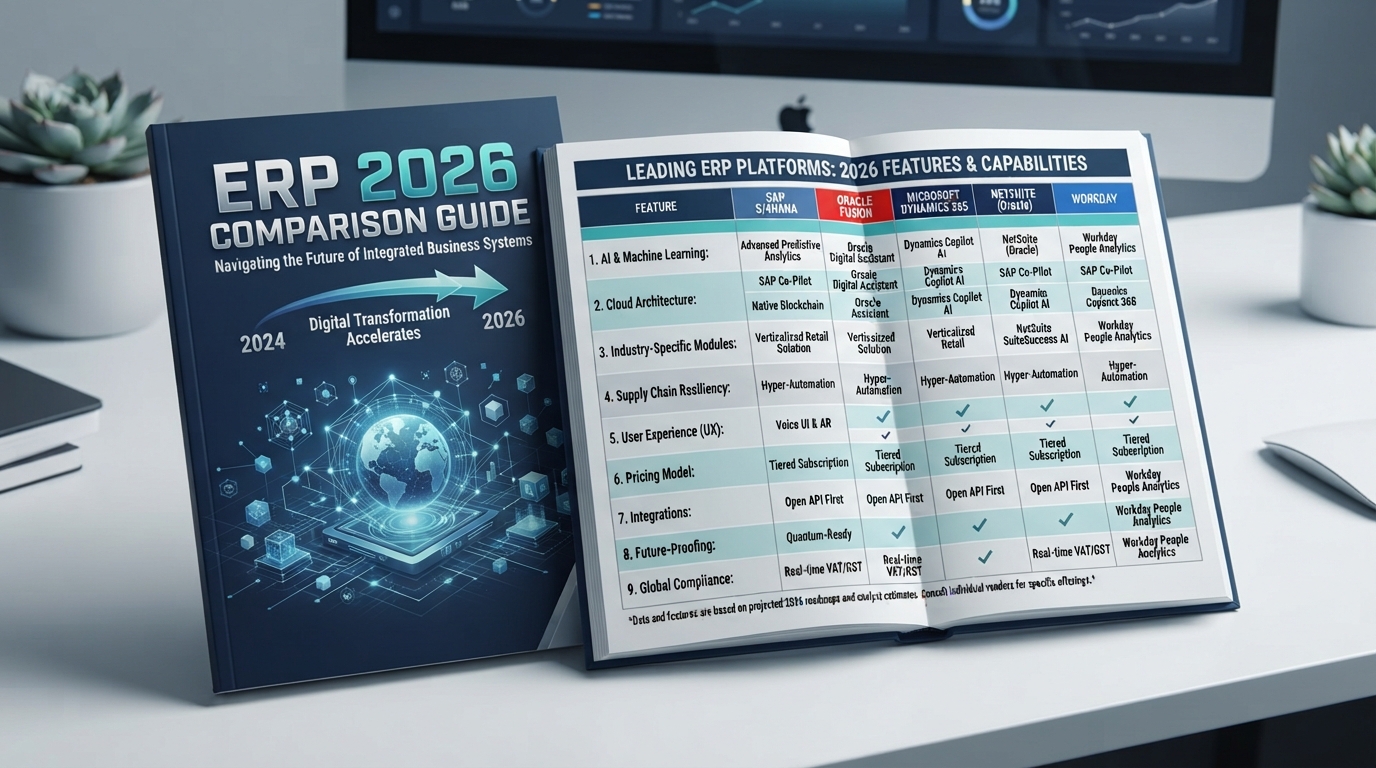
Quick answer: There is no ERP that is universally better than SAP. However, Oracle Fusion Cloud ERP, Microsoft Dynamics 365, Oracle NetSuite, and Acumatica can be better alternatives to SAP for particular businesses and use cases. Oracle Fusion is one of the closest alternatives for large enterprises, Dynamics 365 is attractive for Microsoft-centered organizations, NetSuite can be a better fit for growing mid-market businesses, and Acumatica can be particularly attractive for operationally focused and construction businesses.
Thank you for reading this post, don't forget to subscribe!Thank you for reading this post, don't forget to subscribe!SAP remains one of the most important ERP platforms in the market. Current 2026 ERP research continues to place SAP S/4HANA among the leading enterprise systems, alongside Oracle, Microsoft, NetSuite, and other major platforms.
What Does “Better Than SAP” Actually Mean?
The first mistake companies make when comparing ERP systems is treating “better” as a universal measurement.
An ERP can be better than SAP in one area and weaker in another.
For example:
- A company may prefer Oracle Fusion Cloud ERP for certain finance, analytics, or Oracle-cloud requirements.
- A Microsoft-focused company may prefer Dynamics 365 because of its integration with Microsoft products and business applications.
- A growing mid-market company may prefer NetSuite because it wants a unified cloud ERP without deploying a large enterprise platform.
- A construction company may prefer Acumatica Construction Edition, Sage Intacct Construction, CMiC, or Trimble Viewpoint because construction-specific workflows matter more than having a general enterprise ERP.
Therefore, the better question is:
Which ERP is a better fit than SAP for my company?
Top SAP Alternatives in 2026
| ERP | Best Fit | Why Consider It Instead of SAP? |
|---|---|---|
| Oracle Fusion Cloud ERP | Large enterprises | Strong enterprise finance, analytics, cloud architecture and Oracle ecosystem |
| Microsoft Dynamics 365 | Mid-market to enterprise | Strong Microsoft ecosystem integration and modular applications |
| Oracle NetSuite | Growing and mid-market companies | Cloud-first ERP with a strong unified financial and operational model |
| Acumatica | Growing mid-market businesses | Flexible cloud ERP and strong industry-specific capabilities |
| Infor CloudSuite | Large industry-focused organizations | Deep industry-specific ERP capabilities |
Current SAP alternative research identifies NetSuite and Dynamics 365 as realistic S/4HANA alternatives for mid-market buyers, while Infor CloudSuite and other industry-focused systems can make sense where specialized functionality is important.
1. Oracle Fusion Cloud ERP vs SAP S/4HANA
Best alternative for large enterprises
If the question is specifically “What ERP competes most directly with SAP?”, Oracle Fusion Cloud ERP deserves to be near the top of the list.
Both platforms target complex organizations with substantial financial, procurement, supply chain, project, and operational requirements.
Oracle Fusion Cloud ERP is particularly strong around financial management, analytics, automation, procurement, and Oracle's broader cloud ecosystem.
Independent 2026 ERP research describes Oracle Fusion Cloud ERP as the closest tier-one competitor to SAP S/4HANA for large, complex, multi-entity organizations.
Oracle Fusion may be better than SAP when:
- Your organization already uses Oracle Cloud.
- Finance and financial analytics are major priorities.
- You want Oracle's broader technology ecosystem.
- You want a cloud-native enterprise architecture.
- Your organization wants to evaluate Oracle and SAP head-to-head at enterprise scale.
SAP may be stronger when:
- You have highly complex manufacturing operations.
- You require deep global supply-chain processes.
- Your industry has established SAP processes.
- You already have significant SAP investment and expertise.
- Your organization relies heavily on SAP's ecosystem and integrations.
Verdict: Oracle Fusion Cloud ERP is not simply “better than SAP.” It is one of the strongest alternatives when a large enterprise wants to compare SAP against another tier-one enterprise ERP.
2. Microsoft Dynamics 365 vs SAP
Best for Microsoft-centered organizations
Microsoft Dynamics 365 can be a compelling SAP alternative for companies already deeply invested in Microsoft technology.
The Dynamics 365 portfolio includes different applications for finance, supply chain, sales, customer service, field service, projects, and other business processes.
This creates a different approach from selecting one large ERP platform.
Why companies consider Dynamics 365 instead of SAP
- Integration with Microsoft 365
- Integration with Teams
- Power BI analytics
- Microsoft cloud ecosystem
- Modular application approach
- Strong financial management
- Supply-chain capabilities
- Project and field-service functionality
- Extensive customization and integration options
Current 2026 comparisons describe Dynamics 365 as particularly attractive to mid-to-large businesses already operating within the Microsoft ecosystem.
Dynamics 365 may be better than SAP when:
- Your organization already uses Microsoft 365 extensively.
- Your employees rely on Teams and Excel.
- Power BI is central to your reporting strategy.
- You prefer a modular business application strategy.
- You need strong field service or asset-management capabilities.
Verdict: Dynamics 365 is one of the strongest alternatives to SAP for organizations that want ERP closely connected to Microsoft's broader business ecosystem.
3. Oracle NetSuite vs SAP
Best for growing and mid-market companies
Oracle NetSuite is often a more appropriate alternative when a business has outgrown basic accounting software but does not need the complexity of a large SAP implementation.
NetSuite combines financial management with capabilities such as inventory, order management, project management, CRM, ecommerce, and multi-subsidiary operations.
Current ERP comparisons position NetSuite as a strong SAP alternative for fast-growing mid-market organizations seeking unified cloud ERP.
NetSuite may be better than SAP when:
- You are a mid-market or rapidly growing company.
- You want a unified cloud ERP.
- You want to avoid unnecessary enterprise complexity.
- You need strong multi-subsidiary financial management.
- You want finance, inventory, ecommerce, CRM, and operations connected.
SAP may be better when:
- Your operations are extremely complex.
- You need very deep enterprise manufacturing functionality.
- You have a large global supply chain.
- You require extensive industry-specific enterprise processes.
Verdict: NetSuite can be a better fit than SAP for many growing companies, but it should not be viewed as a universal SAP replacement for large enterprises.
4. Acumatica vs SAP
Best for flexible mid-market operations
Acumatica is particularly interesting when a company wants cloud ERP capabilities but needs flexibility and industry-specific functionality without moving directly into the complexity associated with large enterprise platforms.
Acumatica is used across areas including construction, distribution, manufacturing, field service, and other industries.
Current ERP comparisons identify Acumatica as a significant mid-market alternative, with particular strength in operational areas such as construction and manufacturing.
Acumatica may be better than SAP when:
- Your company is mid-market.
- You need operational flexibility.
- You want industry-specific functionality.
- You operate construction or project-based businesses.
- You want to avoid implementing an enterprise ERP that is larger than necessary.
Verdict: Acumatica is not a direct one-for-one replacement for SAP at every enterprise level. Its value is strongest when the organization wants a flexible ERP appropriate for its size and operational requirements.
5. Infor CloudSuite vs SAP
Best for industry-specific enterprise operations
Infor CloudSuite is another major SAP alternative, particularly for organizations that prioritize industry-specific ERP functionality.
Infor's portfolio covers industries such as manufacturing, distribution, healthcare, public sector, and other verticals.
Current SAP alternative research identifies Infor CloudSuite as a platform worth considering for large organizations that need industry-specific cloud ERP.
This makes Infor particularly relevant when a company wants an ERP that is closely aligned with its specific industry rather than selecting a broad general-purpose ERP and customizing it extensively.
SAP vs Its Main Alternatives
| ERP | Company Size | Strongest Reason to Consider It | Potential Limitation |
|---|---|---|---|
| SAP S/4HANA | Mid-market / Enterprise | Deep enterprise processes | Complexity and implementation effort |
| Oracle Fusion Cloud ERP | Enterprise | Enterprise finance and Oracle cloud ecosystem | Still requires substantial implementation |
| Microsoft Dynamics 365 | Mid-market / Enterprise | Microsoft ecosystem integration | Product portfolio can be complex |
| Oracle NetSuite | Mid-market | Unified cloud ERP for growing businesses | May not match SAP's depth for some complex enterprises |
| Acumatica | SMB / Mid-market | Flexible operations and industry editions | Not designed to replace every SAP enterprise scenario |
| Infor CloudSuite | Mid-market / Enterprise | Industry-specific ERP | Best fit depends heavily on industry |
Is Oracle Better Than SAP?
For some organizations, yes. For others, no.
Oracle offers multiple ERP products, including Oracle Fusion Cloud ERP for enterprise organizations and Oracle NetSuite for a different segment of the market.
Oracle Fusion Cloud ERP is one of the closest competitors to SAP S/4HANA at enterprise scale. NetSuite is more commonly considered when a growing or mid-market business wants a cloud ERP with less enterprise complexity.
Current independent comparisons describe SAP and Oracle Fusion as two flagship enterprise ERP suites, with SAP particularly strong in complex manufacturing and global supply chains and Oracle Fusion particularly strong in finance, analytics, cloud architecture, and automation.
Is Microsoft Dynamics Better Than SAP?
Microsoft Dynamics 365 can be better for an organization whose technology strategy is already centered around Microsoft.
For example, a company heavily dependent on Microsoft 365, Teams, Power BI, Azure, Excel, and other Microsoft services may find the Dynamics ecosystem strategically attractive.
However, companies with highly complex manufacturing, global supply-chain, or established SAP processes may find SAP's depth more appropriate.
The decision should therefore be based on business processes, not simply which software has more features.
Is NetSuite Better Than SAP?
For a growing mid-market company, NetSuite can be a better fit.
For a multinational enterprise with extremely complex manufacturing and supply-chain processes, SAP may remain the stronger fit.
Current 2026 ERP research places NetSuite among the major alternatives to SAP for fast-growing mid-market organizations, while SAP S/4HANA remains positioned toward complex enterprise environments.
The key issue is not which product has more features. The issue is whether the ERP's features match the company's actual processes without excessive customization.
What ERP Is Better Than SAP for Construction?
This is a very different question from asking which ERP is better than SAP for a global manufacturer.
Construction companies have specialized financial and operational requirements that include:
- Job costing
- Cost codes
- Work-in-progress reporting
- Progress billing
- Retainage
- Change orders
- Subcontractor management
- Commitments
- Purchase orders
- Labor costing
- Equipment costs
- Project forecasting
- Certified payroll where applicable
- Field-to-office workflows
Current construction ERP research identifies platforms such as CMiC, Sage Intacct Construction, Acumatica Construction, Trimble Viewpoint, Foundation Software, and Procore among the major systems evaluated for construction.
Some construction companies may therefore find a construction-specific ERP more appropriate than SAP simply because it is designed around contractor workflows.
For a dedicated construction comparison, read:
What Is the Best ERP for Construction?
That guide is a better next step if your primary goal is selecting ERP software for a general contractor, specialty contractor, construction company, or project-based business.
Construction ERP Alternatives to SAP
| Platform | Potential Construction Fit | Best For |
|---|---|---|
| Acumatica Construction Edition | High | Growing construction businesses needing flexible cloud ERP |
| Sage Intacct Construction | High | Construction financial management and multi-entity operations |
| CMiC | High | Large and complex contractors |
| Trimble Viewpoint | High | Established contractors with complex construction operations |
| Foundation Software | High | Construction accounting and payroll-focused operations |
Construction ERP research emphasizes that the most important criteria are not generic ERP features but capabilities such as job costing, progress billing, retainage, subcontractor compliance, and project financial control.
Why Construction Companies Should Not Choose an ERP by Brand Name Alone
SAP is a globally recognized ERP brand, but construction companies should not select an ERP simply because it has a stronger brand or a longer feature list.
A construction company should test the actual workflow:
- Create a project.
- Build a project budget.
- Assign cost codes.
- Create purchase orders.
- Enter subcontractor commitments.
- Track labor and materials.
- Process a change order.
- Prepare progress billing.
- Track retainage.
- Calculate project profitability.
- Produce WIP reports.
- Connect payroll to project costs.
If the ERP cannot handle these workflows naturally, the company may need extensive customization or additional construction applications.
When Should a Company Choose SAP?
SAP remains a strong choice when the organization needs sophisticated enterprise-wide processes.
SAP may make sense when:
- The organization is large or multinational.
- Manufacturing is highly complex.
- Supply chains are extensive.
- Multiple entities and countries must be managed.
- The company already has SAP expertise.
- Industry-specific SAP capabilities are important.
- The organization can support a substantial implementation program.
In other words, looking for an alternative to SAP does not mean SAP is a poor ERP. It means the business should determine whether SAP's scale and complexity match its actual requirements.
When Should You Consider an SAP Alternative?
An alternative may be worth evaluating when:
- SAP is significantly more complex than your business requires.
- Implementation costs exceed your budget.
- Your organization wants a faster cloud deployment.
- You are heavily invested in another technology ecosystem.
- You need specialized industry functionality.
- Your company has outgrown entry-level accounting software but does not need a large enterprise suite.
- Your users need a simpler interface and workflow.
- You want to reduce customization.
The objective should be to find the smallest ERP that can reliably support the company's future operating model, not simply the biggest ERP available.
How to Choose an ERP Better Than SAP for Your Business
- Define the business problem. Identify why you are replacing or avoiding SAP.
- List your must-have processes. Include finance, purchasing, inventory, projects, payroll, manufacturing, CRM, and reporting.
- Identify industry requirements. Construction companies, manufacturers, distributors, and professional services firms need different ERP capabilities.
- Compare implementation effort. Software features mean little if implementation becomes excessively complicated.
- Calculate total cost of ownership. Include software, implementation, integrations, training, support, and customization.
- Test the actual workflows. Use real business scenarios during demonstrations.
- Check integration requirements. Confirm compatibility with payroll, banking, CRM, field applications, and other systems.
- Consider future growth. The ERP should support your expected expansion without forcing another replacement.
Frequently Asked Questions
Which ERP is better than SAP?
No single ERP is universally better than SAP. Oracle Fusion Cloud ERP is one of the closest enterprise alternatives, Microsoft Dynamics 365 is attractive for Microsoft-centered organizations, NetSuite is often better suited to growing mid-market companies, and Acumatica can be attractive for flexible industry-focused operations.
What is the biggest competitor to SAP?
Oracle is one of SAP's closest enterprise competitors. Oracle Fusion Cloud ERP competes directly with SAP S/4HANA in large and complex organizations. Microsoft Dynamics 365 is another major alternative, particularly for companies already invested in Microsoft's ecosystem.
Is Oracle better than SAP?
Oracle Fusion Cloud ERP can be a better fit for some organizations, particularly those prioritizing Oracle's cloud ecosystem, finance, analytics, and automation. SAP may be preferable for organizations requiring deep manufacturing, global supply-chain, or established SAP-specific processes.
Is Microsoft Dynamics better than SAP?
Microsoft Dynamics 365 can be a better fit for businesses heavily invested in Microsoft 365, Teams, Power BI, Azure, and other Microsoft technologies. SAP can remain a stronger fit for certain highly complex global enterprise environments.
Is NetSuite better than SAP?
NetSuite can be better for many growing and mid-market companies that want unified cloud ERP without the scale of a large enterprise implementation. SAP may be more appropriate for large organizations with complex global operations.
What is the best SAP alternative for small businesses?
Small businesses generally should not choose an ERP simply because it competes with SAP. Depending on requirements, options such as Microsoft Dynamics 365 Business Central, Acumatica, or other SMB-focused systems may be more appropriate.
What is the best SAP alternative for construction?
There is no universal winner. Construction companies should compare construction-specific systems such as Acumatica Construction Edition, Sage Intacct Construction, CMiC, Trimble Viewpoint, and Foundation Software based on job costing, WIP, project billing, payroll, subcontractor management, and field requirements.
Read: What Is the Best ERP for Construction?
Is SAP still worth using in 2026?
Yes. SAP remains a major enterprise ERP platform in 2026 and continues to be included among the leading ERP systems. The more useful question is whether SAP is the right fit for a particular company's size, industry, operating model, budget, and implementation capability.
Can a construction company use SAP?
Yes. SAP can support construction and engineering organizations, but construction companies should evaluate whether SAP provides the desired construction workflows natively or through industry solutions, configuration, integrations, and additional applications.
Related Construction ERP Resources
Final Verdict: Which ERP Is Better Than SAP?
If you are asking which ERP is simply “better than SAP,” there is no single answer.
Instead, consider the alternative that best matches your situation:
- Oracle Fusion Cloud ERP – one of the strongest direct enterprise alternatives to SAP S/4HANA.
- Microsoft Dynamics 365 – particularly attractive for organizations built around Microsoft technologies.
- Oracle NetSuite – often a better fit for growing and mid-market companies seeking unified cloud ERP.
- Acumatica – attractive for flexible mid-market operations and industry-specific requirements.
- Infor CloudSuite – worth considering when deep industry-specific functionality is important.
For construction companies, the answer can be completely different. A contractor may get more value from a construction-specific ERP that handles job costing, WIP, progress billing, retainage, subcontractors, payroll, and project forecasting as core workflows.
→ Compare the Best ERP Systems for Construction
The best SAP alternative is therefore not necessarily the ERP with the most features. It is the ERP that delivers the required business processes with the right level of complexity, cost, industry fit, and implementation risk.