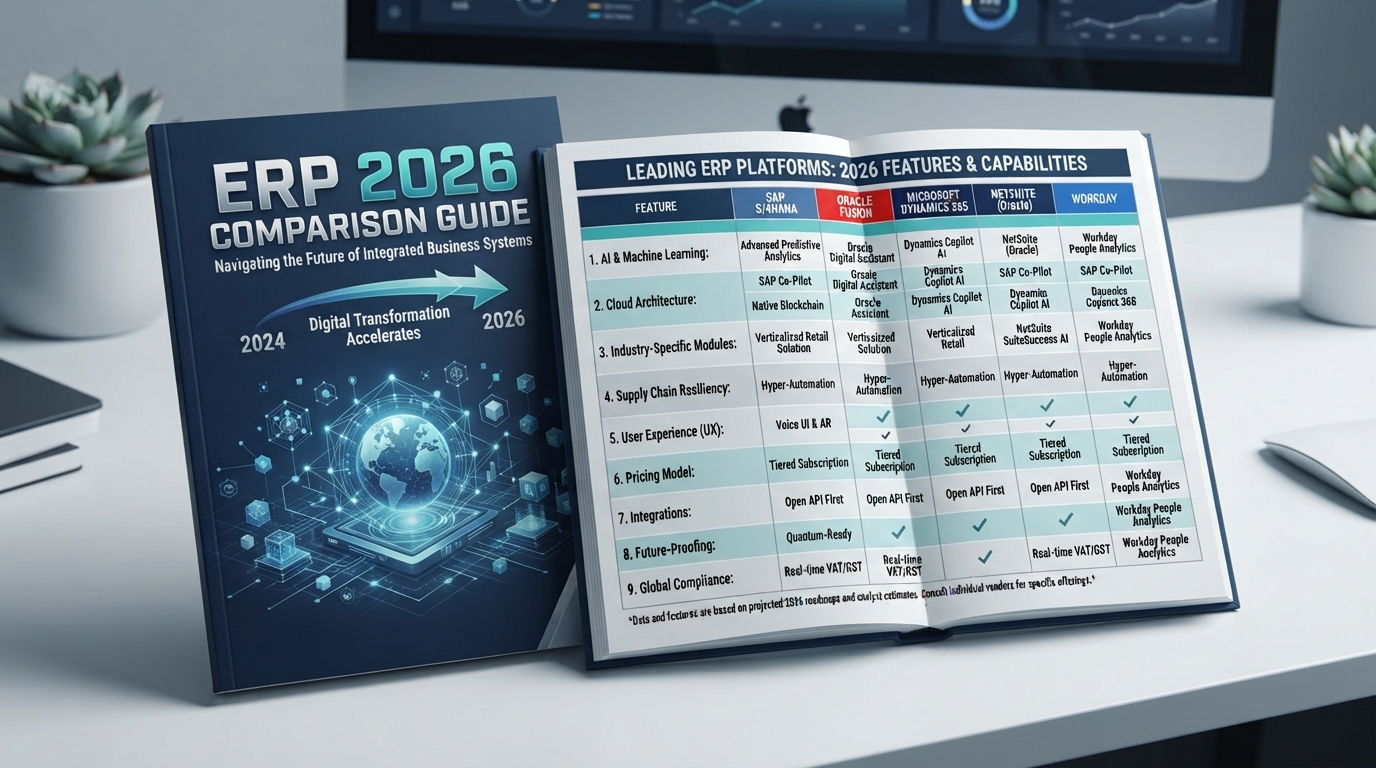
ERP is not being completely replaced by one new type of software. Instead, traditional all-in-one ERP systems are being reshaped by AI, composable ERP, best-of-breed applications, cloud platforms, APIs, and industry-specific software.
Thank you for reading this post, don't forget to subscribe!Thank you for reading this post, don't forget to subscribe!In 2026, the biggest shift is from a rigid ERP suite that tries to control every business process toward a more flexible technology architecture where a core ERP works alongside specialized applications, automation, real-time data platforms, and AI agents.
For construction companies, this distinction is particularly important. A contractor may still need an ERP or financial system as the system of record while using separate construction management, estimating, job costing, payroll, time tracking, field operations, procurement, and AI tools around it.
Short answer: The technologies most often described as alternatives or successors to traditional ERP include composable ERP, best-of-breed SaaS applications, AI-native business software, industry-specific cloud platforms, and integrated business ecosystems. However, current research generally points toward ERP modernization rather than simply eliminating ERP.
What Is Replacing Traditional ERP?
There is no single replacement for ERP. Instead, several technologies are changing how companies organize enterprise software.
| Technology | What It Does | Why It Matters |
|---|---|---|
| Composable ERP | Combines a core ERP with modular applications and services. | Provides more flexibility than a single monolithic suite. |
| AI-native software | Uses AI agents and automation to execute business processes. | Reduces manual work and can turn software from a system of record into a system of action. |
| Best-of-breed SaaS | Uses specialized cloud applications for individual functions. | Allows businesses to select specialized tools instead of relying on one vendor for everything. |
| Industry-specific platforms | Combines workflows designed for a particular industry. | Provides functionality that generic ERP systems may not handle deeply. |
| Integrated business platforms | Connects financial, operational, customer, workforce and data applications. | Creates an ecosystem without requiring every function to live inside one application. |
1. Composable ERP Is One of the Biggest ERP Alternatives
Composable ERP is one of the most important concepts in the future of enterprise software.
Instead of purchasing one enormous ERP suite and accepting its entire collection of modules, a company can maintain a core system while connecting specialized applications through APIs, integrations and shared data.
For example, a construction company could use one system for financial accounting, another for construction project management, another for payroll and another for field time tracking while connecting them into a coordinated technology environment.
Gartner's 2026 research specifically describes cloud ERP modernization in the context of a composable ERP strategy.
Deloitte similarly describes the future as a modular, API-driven and agent-enabled ERP architecture rather than simply throwing away ERP altogether.
Why Companies Are Moving Toward Composable ERP
- Businesses can choose specialized applications.
- New applications can be added without replacing the entire core system.
- APIs make it easier to connect different systems.
- Companies can modernize one function at a time.
- AI tools can operate on top of existing enterprise data.
- Businesses can reduce dependence on one software vendor.
2. AI Is Changing What ERP Software Does
Artificial intelligence may be the most significant force changing ERP software.
Traditional ERP systems primarily record transactions, enforce workflows and provide reports. The emerging model adds AI that can interpret information, recommend actions, automate repetitive work and, in some cases, execute tasks.
Gartner describes this evolution as a movement from ERP as a system of record toward a system of action, driven by AI, composable architecture and real-time data orchestration.
McKinsey also describes AI agents and generative AI as technologies that can operate on top of enterprise applications and automate or orchestrate processes across the organization.
What Could AI Replace Inside ERP?
AI is more likely to replace manual ERP activities than ERP itself.
- Manual data entry
- Invoice processing
- Basic reconciliations
- Routine reporting
- Data classification
- Employee onboarding workflows
- Basic forecasting
- Document processing
- Exception detection
- Routine financial analysis
For example, instead of an accounting employee manually searching for unusual transactions, an AI system could identify exceptions and present them for review.
This is why asking whether “AI will replace ERP” can be misleading. Gartner's 2026 research advises organizations not to attempt to replace the entire ERP with AI, but instead to augment ERP with AI because ERP still provides important controls, data structures and compliance capabilities.
3. Best-of-Breed Software Is Replacing the One-Suite Approach
Another major alternative to traditional ERP is the best-of-breed software stack.
Rather than asking, “Which ERP can do everything?” businesses increasingly ask, “Which application is best for each important function, and how can we connect them?”
For example, a company might use:
- A financial management platform for accounting.
- A specialized CRM for sales.
- A workforce platform for HR.
- A dedicated payroll system.
- A project management platform.
- A specialized procurement application.
- A business intelligence platform.
- An AI automation platform.
CIO's 2026 analysis of ERP trends describes a market in which AI is taking over more ERP functionality while modular and best-of-breed applications are replacing portions of traditional all-in-one ERP suites.
4. Industry-Specific Software Is Becoming More Important
Generic ERP systems are designed to support broad business processes. But many industries have workflows that require much deeper specialization.
This is especially true for construction.
A construction company does not simply need accounting software. It may need:
- Job costing
- Project accounting
- Construction estimating
- Subcontract management
- Commitments and purchase orders
- Change-order management
- Progress billing
- Retainage tracking
- Construction payroll
- Time tracking
- Union payroll
- Prevailing-wage calculations
- Certified payroll reporting
- Field management
- Equipment management
- Project forecasting
Modern construction ERP platforms increasingly combine financial control with project delivery, cost management, subcontract management and other construction-specific workflows.
That means a construction company may not necessarily replace ERP with one application. Instead, it may build a construction technology ecosystem around its financial core.
If you are comparing ERP options specifically for a contractor, see our guide to What Is the Best ERP for Construction?.
5. Cloud Platforms Are Replacing Legacy On-Premise ERP Deployments
Another major change is the move away from traditional on-premise ERP infrastructure.
Cloud ERP allows organizations to access business systems through internet-based infrastructure rather than maintaining the entire software environment themselves.
Modern cloud platforms can also make it easier to connect applications, deploy updates and introduce new AI capabilities.
Recent ERP market data shows how widespread cloud deployment has become. ERP Research's October 2026 analysis found that 89% of the ERP systems it tracks offer cloud deployment, while 41% are cloud-only.
This does not mean every company should immediately abandon on-premise software. Regulatory requirements, data sovereignty, existing infrastructure and business risk can still make deployment strategy an important decision.
6. Data Platforms and APIs Are Becoming the Connecting Layer
One of the biggest weaknesses of a collection of specialized applications is fragmented data.
If accounting, payroll, CRM, project management and field applications cannot communicate, the business can end up with multiple versions of the truth.
That is why APIs, integration platforms, data warehouses, analytics platforms and shared data models are becoming increasingly important.
The goal is not necessarily to put everything into one application. The goal is to make information available across the applications that need it.
In this model, the architecture can look like:
Core financial system → APIs → specialized applications → data platform → AI and analytics
This approach can provide some of the benefits of ERP integration without requiring every business function to be delivered by the same software vendor.
Traditional ERP vs. the Emerging Model
| Traditional ERP | Emerging Enterprise Architecture |
|---|---|
| Large integrated suite | Composable ecosystem |
| Primarily system of record | System of record plus system of action |
| Human-driven workflows | AI-assisted and increasingly agent-driven workflows |
| One major vendor | Multiple connected vendors |
| Large implementation projects | Potentially phased modernization |
| Standardized modules | Specialized applications and services |
| Periodic reporting | Real-time data and intelligence |
| Manual navigation through software | Conversational and AI-assisted interfaces |
Is ERP Becoming Obsolete?
No. ERP is not becoming obsolete.
The more accurate description is that ERP is evolving.
ERP remains valuable because companies still need reliable financial records, controls, audit trails, standardized processes and a trusted source of business information.
Deloitte's 2026 analysis specifically argues that the future is ERP modernization rather than simply replacing ERP, with a leaner core surrounded by flexible applications and AI agents.
The question is therefore changing from:
“What will replace ERP?”
to:
“What should sit around the ERP, and which functions should AI or specialized applications handle?”
What Is Replacing ERP in Construction?
Construction provides a useful example of this transition.
A modern contractor may use an accounting or ERP platform as its financial foundation while connecting it with construction-specific software.
| Construction Function | Possible Technology Layer |
|---|---|
| General accounting | ERP or financial management system |
| Job costing | Construction accounting / ERP |
| Estimating | Construction estimating software |
| Project management | Construction management platform |
| Field operations | Mobile field software |
| Time tracking | Construction workforce application |
| Payroll | Construction payroll platform |
| Certified payroll | Specialized compliance software |
| AI analysis | AI agents and analytics |
| Business intelligence | Data and reporting platform |
This architecture can be particularly useful for contractors because construction workflows can be highly specialized. Current construction ERP research emphasizes functions such as job costing, progress billing, retainage and subcontractor compliance as important requirements when evaluating construction systems.
Could AI Replace Construction ERP?
AI could automate many activities performed through construction ERP software, but it is unlikely to eliminate the need for a trusted financial and operational system in the near term.
For example, AI could potentially help a contractor:
- Identify projects with declining margins.
- Analyze labor-cost trends.
- Detect unusual job-cost transactions.
- Summarize project financial performance.
- Forecast cash-flow problems.
- Analyze change orders.
- Flag missing payroll information.
- Compare estimated versus actual labor costs.
- Generate management reports.
- Assist with invoice and document processing.
But the underlying system still needs reliable records for payroll, accounting, contracts, job costs, vendors, customers and project transactions.
In other words, AI may become the interface and automation layer while ERP remains part of the underlying data and control layer.
Why Businesses Are Moving Away From Traditional ERP Architectures
Traditional ERP implementations can be expensive and disruptive. Businesses may also find themselves locked into a vendor's functionality, release schedule and technology architecture.
The emerging approach can address some of these problems by allowing companies to modernize incrementally.
1. Faster Innovation
Specialized SaaS vendors can focus intensely on a particular business problem instead of building every feature required by every industry.
2. Greater Flexibility
Companies can replace individual components without necessarily replacing their entire business system.
3. Better Industry Fit
Specialized applications can provide deeper workflows for industries such as construction, healthcare, manufacturing, logistics and professional services.
4. More AI Opportunities
AI agents can interact with data from multiple enterprise applications instead of being limited to a single ERP module.
5. Phased Modernization
Companies can modernize selected functions instead of attempting a complete enterprise replacement in one project.
What Are the Risks of Replacing ERP With Multiple Applications?
A multi-application strategy is not automatically better.
The biggest risk is creating a collection of disconnected systems that increases complexity rather than reducing it.
- Data duplication: Multiple applications may contain conflicting information.
- Integration problems: Systems may fail to exchange data reliably.
- Security risks: More applications can mean more access points.
- Vendor management: The company must manage multiple software relationships.
- Implementation complexity: Integrating systems can be difficult.
- Reporting problems: Data may need to be consolidated before management can analyze it.
- Compliance issues: Financial and operational controls still need to be maintained.
For this reason, the objective should not be to eliminate ERP simply because newer software exists. The objective should be to build an architecture that is integrated, secure, scalable and appropriate for the company's processes.
What Should a Company Use Instead of ERP?
There is no universal answer.
A small company may not need a traditional enterprise ERP at all. It might use cloud accounting software combined with payroll, CRM, project management and other specialized applications.
A growing company may need a modern cloud ERP with specialized applications connected to it.
A large enterprise may require an ERP core combined with industry applications, data platforms, automation and AI agents.
The right architecture depends on business size, industry, transaction complexity, compliance requirements, geographic footprint and internal technology capabilities.
How to Decide Whether to Replace or Modernize Your ERP
Before replacing an ERP, ask these questions:
- Which ERP functions are actually causing problems?
- Is the problem the software or the way it has been configured?
- Which processes require specialized software?
- Can the existing ERP integrate with modern applications?
- Can AI improve the current workflow without replacing the core system?
- How important are financial controls and auditability?
- How difficult would a complete migration be?
- Would a phased modernization reduce business risk?
- Who will own integrations and data governance?
- What is the total cost over five years?
What Is the Future of ERP?
The future of ERP is likely to be less about one giant application and more about an intelligent enterprise architecture.
The ERP core will continue to manage important records, controls and standardized processes. Around that core, businesses will increasingly use specialized applications, APIs, cloud services, real-time data platforms and AI agents.
Gartner's 2026 research highlights AI-powered ERP, real-time intelligence, automation and action as key themes in the evolution of enterprise resource planning.
At the same time, Deloitte argues that businesses should modernize ERP rather than assume that AI makes the ERP foundation unnecessary.
That suggests the likely future is not “no ERP.”
It is more likely to be:
ERP + AI + specialized applications + APIs + real-time data + automation.
Frequently Asked Questions
What is replacing ERP?
Nothing is replacing ERP completely. Traditional ERP is being supplemented and reshaped by composable ERP, best-of-breed SaaS applications, cloud platforms, industry-specific software, APIs and AI agents.
Will AI replace ERP?
AI is more likely to augment and automate ERP than completely replace it. ERP continues to provide important financial records, controls, standardized processes and trusted business data. Gartner recommends augmenting ERP with AI rather than attempting to replace the entire ERP with AI.
What is composable ERP?
Composable ERP is an approach where a business uses a core ERP together with modular applications and services that can be connected through APIs and other integration technologies.
Is ERP becoming obsolete?
No. ERP is evolving from a primarily transactional system of record into a more intelligent, connected and increasingly automated business platform.
What is better than ERP for a small business?
A small business may not need a traditional ERP. Cloud accounting software combined with specialized payroll, CRM, project management and other applications may provide a simpler solution until the company's complexity justifies ERP.
What is replacing ERP in construction?
Construction companies are increasingly combining construction-specific applications with financial systems, cloud platforms, APIs, analytics and AI. The result is often a connected construction technology ecosystem rather than one application handling every function.
Will construction companies still need ERP?
Many growing and larger contractors will continue to need ERP or construction ERP capabilities for financial control, job costing, project accounting, procurement, subcontractor management and other core processes. The difference is that these systems will increasingly connect with specialized field, payroll, project and AI applications.
Final Takeaway: ERP Is Evolving, Not Disappearing
The best answer to “What is replacing ERP?” is not one piece of software.
The traditional ERP model is being transformed by composable architecture, cloud software, best-of-breed applications, industry-specific platforms, APIs, real-time data and AI agents.
For some businesses, this may mean moving away from a large monolithic ERP. For others, it will mean keeping the ERP core while replacing individual modules with better specialized applications.
For construction companies, the second approach can be especially practical. Contractors still need reliable financial and project data, but they can increasingly connect specialized tools for job costing, payroll, field operations, project management, compliance and workforce management.
So rather than asking only “What will replace ERP?”, businesses should ask:
“What should our ERP continue to do, what should specialized software handle, and where can AI automate the work?”
That is the direction in which enterprise software is moving in 2026.
Research & Sources
This article follows an AI-first research approach: the primary question is answered near the beginning, major claims are supported by current research, and the distinction between ERP replacement and ERP modernization is made explicit.
- Gartner — Cloud ERP services and composable ERP strategy.
- Gartner — “Can AI Replace My ERP?” 2026 research.
- Deloitte — ERP modernization in the agentic AI era.
- McKinsey — AI disruption and the changing ERP model.
- CIO — ERP trends, AI and best-of-breed applications in 2026.
- IFS — Construction ERP buyer guidance and construction technology requirements.