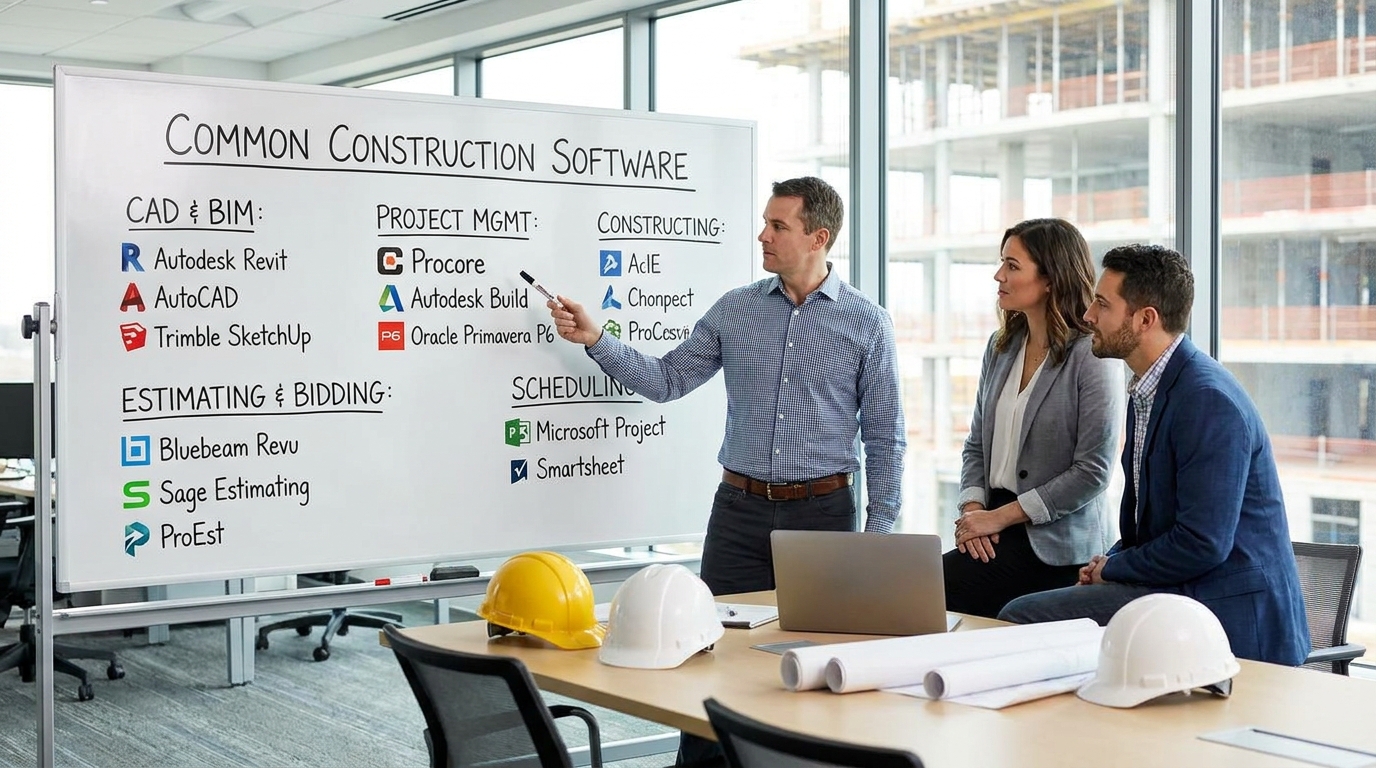
Construction companies use many different types of software because a modern construction project involves much more than scheduling workers and tracking materials. Contractors may use separate or integrated systems for project management, estimating, scheduling, accounting, payroll, BIM, document management, field operations, safety, procurement and customer management.
Thank you for reading this post, don't forget to subscribe!Thank you for reading this post, don't forget to subscribe!The software most commonly used in the construction industry falls into several major categories: construction project management, estimating and takeoff, scheduling, accounting and job costing, BIM and design, field management, document management, construction payroll, ERP and CRM software.
Among widely recognized construction platforms in 2026 are Procore, Autodesk Forma, Fieldwire, Buildertrend, HCSS, Oracle Primavera, Contractor Foreman, Bluebeam, Sage Construction Management and other specialized systems. The right combination depends on the size and type of construction company.
There is no single software package used by every construction company. A residential builder, commercial general contractor, heavy civil contractor and specialty subcontractor can have very different technology requirements.
Current construction-software listings also demonstrate how fragmented the category is. G2's 2026 construction software data includes project-management platforms such as Autodesk Forma, Procore and Fieldwire, while other categories cover bid management, accounting, analytics and specialized construction workflows.
What Types of Software Are Used in Construction?
The construction industry commonly uses software for the following functions:
- Construction project management
- Construction estimating and quantity takeoff
- Construction scheduling
- Accounting and job costing
- Building Information Modeling (BIM)
- Field management
- Document management
- Construction payroll
- Time tracking
- Procurement and purchasing
- Safety and quality management
- Customer relationship management
- Enterprise resource planning (ERP)
- Reporting and construction analytics
Some modern construction platforms combine several of these functions. Others are designed for one specialized purpose and integrate with the rest of the company's technology stack.
1. Construction Project Management Software
Construction project management software is one of the most important software categories used by contractors.
It helps project teams coordinate schedules, documents, RFIs, submittals, change orders, daily reports, tasks, budgets and communication between the office and jobsite.
Common examples include:
- Procore
- Autodesk Forma
- Fieldwire
- Buildertrend
- Contractor Foreman
- HCSS
- Oracle Primavera
G2's current 2026 construction project-management category lists Autodesk Forma, Procore, Fieldwire, RDash, Revizto, HCSS and Oracle Aconex among the prominent products in the category.
If you want a shorter list of leading platforms, see our guide to the top 5 construction management software.
2. Construction Estimating and Takeoff Software
Before construction begins, contractors need to determine how much a project is likely to cost.
Construction estimating software helps contractors calculate quantities, labor, materials, equipment, subcontractor costs, overhead and projected margins.
Digital takeoff software can also help estimators measure quantities from drawings instead of manually calculating everything from paper plans.
Examples and platforms used in this area include:
- Autodesk Forma
- Procore
- HCSS
- STACK
- Methvin
- Sage Construction Management
- Contractor Foreman
G2's 2026 estimating-software research identifies Autodesk Forma, Procore and HCSS among the leading options, with other tools specializing in digital takeoff, bid management and preconstruction.
3. Construction Scheduling Software
Construction projects depend heavily on timing. Delays in one activity can affect subcontractors, materials, inspections, labor and project completion.
Construction scheduling software is used to create and manage:
- Project schedules
- Activities
- Milestones
- Dependencies
- Critical paths
- Resources
- Subcontractor activities
- Project deadlines
- Progress updates
Oracle Primavera is particularly associated with complex scheduling and large programs, while other construction-management platforms provide scheduling as part of a broader project-management system.
Autodesk Forma, for example, allows schedule data from systems including Primavera P6, Microsoft Project and ASTA Powerproject to be brought into Forma Build for project collaboration.
4. Construction Accounting and Job Costing Software
Construction accounting is different from simply recording business income and expenses.
Contractors need to understand the financial performance of individual projects, cost codes, phases, labor, materials, subcontractors, commitments, change orders and work in progress.
Construction accounting software can help companies manage:
- General ledger accounting
- Accounts payable
- Accounts receivable
- Job costing
- Work in progress
- Purchase orders
- Subcontractor payments
- Budget versus actual costs
- Change orders
- Financial reporting
G2's current construction-management category includes products such as Procore, GCPay, Acumatica, Deltek ComputerEase, Sage Intacct and Vista within construction accounting.
5. BIM and Construction Design Software
Building Information Modeling (BIM) software is widely used on projects where digital models and coordinated design information are important.
BIM can help project teams visualize buildings, coordinate disciplines, identify clashes and connect design information with construction activities.
The Autodesk ecosystem is particularly important in this area. Autodesk has been integrating Autodesk Construction Cloud into the broader Autodesk Forma platform, connecting design, planning and construction workflows.
Depending on the project, teams may also use:
- Autodesk Revit
- Autodesk Navisworks
- Autodesk Forma
- Revizto
- Bluebeam
- Other BIM and design coordination tools
6. Field Management Software
Construction work happens on the jobsite, so field teams need software that works outside the office.
Construction field management software can help supervisors and crews manage:
- Daily reports
- Tasks
- Drawings
- Photos
- Inspections
- Punch lists
- Issues
- Forms
- Time
- Safety documentation
Fieldwire by Hilti is an example of a field-first construction platform. G2 currently describes Fieldwire as a construction platform focused on connecting field and office teams and lists it among the prominent construction project-management products.
Field management can also be part of larger platforms such as Procore and Autodesk Forma.
7. Construction Document Management Software
Construction projects generate huge amounts of documentation.
These documents can include:
- Architectural drawings
- Structural drawings
- Specifications
- Contracts
- RFIs
- Submittals
- Change orders
- Inspection reports
- Daily reports
- Photos
- Meeting records
- As-built documentation
Document-management software helps teams control revisions and ensure that people are working from current information.
Autodesk Forma, for example, emphasizes centralized project data and connected workflows across construction phases, while Procore provides construction document and project-management workflows.
8. Construction Payroll Software
Construction payroll software is another important category because construction payroll can involve hourly employees, multiple job sites, different labor classifications, overtime, prevailing wages, union rules, certified payroll and job-cost allocation.
Construction companies may need payroll systems that can connect labor costs to specific:
- Projects
- Job sites
- Cost codes
- Employees
- Labor classifications
- Work hours
This is particularly important for contractors working on public projects where certified payroll and prevailing-wage reporting may apply.
If payroll is one of your major requirements, explore our dedicated construction payroll software resources.
9. Construction Time Tracking Software
Time tracking is closely connected to payroll and job costing.
Construction companies use time-tracking systems to record how many hours employees spend on particular projects, activities and cost codes.
A good construction time-tracking workflow can reduce manual timesheets and provide more accurate labor-cost information.
Time data can then feed payroll and project-costing systems where integrations are available.
10. Construction ERP Software
Construction ERP software brings multiple business functions together into a broader enterprise platform.
An ERP may connect:
- Accounting
- Job costing
- Procurement
- Project management
- Payroll
- Human resources
- Inventory
- Equipment
- Reporting
- Business analytics
ERP systems are particularly relevant to larger contractors that need company-wide financial and operational visibility rather than software for only one project.
However, ERP software can be more complex to implement than a focused construction-management application.
11. Construction Safety and Quality Software
Safety and quality are critical parts of construction operations, and many companies use specialized software or modules to manage them.
Typical workflows include:
- Safety inspections
- Incident reporting
- Safety forms
- Quality inspections
- Deficiency tracking
- Punch lists
- Corrective actions
- Compliance documentation
Autodesk Forma, for example, provides construction forms that can be configured for quality and safety data collection and connected to issues and RFIs.
12. Construction CRM Software
Construction companies also need to manage potential clients and business opportunities before a project becomes a job.
Construction CRM software can help contractors track:
- Leads
- Prospects
- Clients
- Sales opportunities
- Estimates
- Proposals
- Follow-ups
- Communication
Some construction platforms combine CRM and project-management functionality, while others integrate with dedicated CRM systems.
Most Common Construction Software Categories at a Glance
| Software Category | What It Does | Typical Users | Examples |
|---|---|---|---|
| Construction Management | Manages projects, documents, field activities and workflows | Contractors, PMs, superintendents | Procore, Autodesk Forma, Fieldwire |
| Estimating & Takeoff | Calculates quantities, costs and bids | Estimators, preconstruction teams | STACK, HCSS, Procore, Methvin |
| Scheduling | Plans activities, milestones and resources | Project managers, planners | Oracle Primavera, Autodesk Forma |
| Accounting & Job Costing | Tracks financial performance and project costs | Accountants, controllers, project managers | Procore, Sage, Acumatica, Vista |
| BIM & Design | Creates and coordinates digital building models | Architects, engineers, BIM teams | Revit, Forma, Navisworks, Revizto |
| Field Management | Manages jobsite tasks, plans, reports and issues | Foremen, superintendents, field teams | Fieldwire, Procore, Raken |
| Payroll | Processes construction labor and payroll | Payroll teams, HR, contractors | Construction payroll platforms |
| ERP | Connects financial and operational functions | Large contractors, executives | Construction ERP platforms |
| Safety & Quality | Manages inspections, incidents and compliance | Safety and quality teams | Specialized safety and construction platforms |
What Software Do General Contractors Commonly Use?
General contractors typically need more than one type of construction software.
A commercial general contractor may use:
- Construction project management software
- Estimating software
- Scheduling software
- Accounting and job-costing software
- Document management
- Field management
- Payroll and time tracking
- BIM and coordination software
- Safety and quality software
For larger projects, the goal is increasingly to connect these systems so that information can move from preconstruction to project execution and eventually closeout.
What Software Do Small Construction Companies Commonly Use?
Small contractors generally do not need every enterprise system available.
A smaller construction company may begin with a combination of:
- Estimating software
- Accounting software
- Construction project management
- Time tracking
- Payroll
- Document storage
As the business grows, it may add more specialized tools for job costing, scheduling, CRM, safety and field management.
Our guide to the best software for a construction company compares platforms based on different company sizes and construction workflows.
What Software Is Used by Commercial Construction Companies?
Commercial construction companies often require stronger document control, cost management, scheduling, subcontractor coordination and project reporting.
Platforms such as Procore and Autodesk Forma are frequently evaluated by commercial construction teams because they provide broader construction-management workflows.
For complex infrastructure and heavy civil work, specialized platforms such as HCSS and Primavera may be more appropriate for particular workflows.
G2's 2026 construction software research identifies HCSS as a platform focused specifically on heavy civil and infrastructure contractors, while Oracle Primavera is positioned for large programs and enterprise scheduling.
Is There One Software That Does Everything in Construction?
Not perfectly.
Some modern construction platforms are increasingly broad and can cover project management, financial information, documents, field operations, reporting and other workflows.
However, construction companies often continue to use several specialized applications because different departments have different requirements.
A contractor may have one system for project management, another for accounting, another for payroll, another for BIM and another for estimating. The important question is whether these systems can share information reliably.
Construction Software vs. General Business Software
A generic project-management platform may provide tasks, calendars, messages and dashboards.
Construction software goes further by addressing industry-specific processes.
Examples include:
- RFIs
- Submittals
- Change orders
- Drawings
- Daily logs
- Job costing
- Construction schedules
- Subcontractor management
- Progress billing
- Certified payroll
- Construction safety documentation
This is why construction companies should not choose software based only on whether it has a task-management feature.
If you are comparing general project-management platforms, read our guide to the top 5 project management software.
How to Choose Construction Software
-
Identify the biggest problem first.
Determine whether your main issue is estimating, scheduling, field communication, accounting, payroll, documents or project control. -
Map your current workflow.
Write down how information moves from sales and estimating through construction, accounting and closeout. -
List the software you already use.
The best new platform should work with your existing technology whenever possible. -
Check integrations.
Accounting, payroll, estimating and project-management systems should ideally exchange information without unnecessary manual entry. -
Test the mobile experience.
Ask actual field employees to test the software rather than relying only on an office demonstration. -
Check reporting.
Make sure managers can obtain the information needed to control cost, schedule and productivity. -
Consider scalability.
A platform should be capable of supporting the company as the number of projects and employees increases. -
Calculate total cost.
Consider subscriptions, implementation, training, integrations, support and additional modules.
What Is the Best Construction Software?
The answer depends on what you mean by "best."
If you mean best overall construction-management platform, Procore and Autodesk Forma are among the major platforms to evaluate.
If you mean best field-focused software, Fieldwire is a major option.
If you mean best residential construction platform, Buildertrend is an important option.
If you mean best heavy-civil platform, HCSS is particularly relevant.
If you mean best scheduling software for complex programs, Oracle Primavera is a major platform to evaluate.
For a direct comparison, see: Which Software Is Best for Construction Management?
You can also compare additional platforms in our top 10 construction management software guide.
Who Has the Best Construction Management Program?
There is no universal winner because construction companies operate differently.
A large commercial general contractor may prioritize cost management, contracts and document control. A residential builder may prioritize estimating, scheduling and customer communication. A heavy civil contractor may need specialized estimating, equipment and field-production workflows.
That is why the "best" construction management program should be selected according to project type and business requirements rather than popularity alone.
For a deeper comparison, see our guide: Who Has the Best Construction Management Program?
Frequently Asked Questions
What software is commonly used in the construction industry?
Common construction software includes project-management, estimating, scheduling, accounting, job-costing, BIM, field-management, payroll, ERP, safety and document-management systems. Examples include Procore, Autodesk Forma, Fieldwire, Buildertrend, HCSS, Oracle Primavera, Contractor Foreman and specialized construction accounting and payroll platforms.
What is the most common construction management software?
There is no single construction-management platform used by every company. Procore, Autodesk Forma and Fieldwire are among the prominent platforms in current 2026 construction project-management listings, while other platforms serve residential, heavy-civil and specialized construction markets.
What software do construction project managers use?
Construction project managers commonly use project-management platforms for schedules, RFIs, submittals, documents, budgets, change orders, daily reports, tasks and communication. They may also use specialized estimating, accounting, scheduling, BIM and field-management software.
Do construction companies use Excel?
Yes. Many construction companies still use spreadsheets for estimates, budgets, tracking and reporting. However, as project volume and complexity increase, dedicated construction software can provide stronger collaboration, automation, permissions, audit trails and integration.
What software is used for construction estimating?
Construction estimating software can include platforms such as HCSS, Procore, Autodesk Forma, STACK, Methvin and Sage Construction Management. The appropriate choice depends on whether the contractor needs quantity takeoff, bid management, cost planning, job costing or a combination of these functions.
What software is used for construction scheduling?
Construction companies use dedicated scheduling platforms such as Oracle Primavera as well as scheduling modules inside broader construction-management platforms such as Autodesk Forma and Procore.
What software is used for construction accounting?
Construction accounting software can include Procore, GCPay, Acumatica, Deltek ComputerEase, Sage Intacct and Vista, among others. The appropriate system depends on company size, accounting requirements and the need for construction-specific job costing.
What software is used for construction payroll?
Construction companies may use specialized payroll systems designed to handle job costing, hourly labor, overtime, prevailing wages, union requirements and certified payroll, depending on the projects and jurisdictions involved.
What is the best software for a construction company?
There is no single best platform for every construction company. Procore, Autodesk Forma, Buildertrend, Fieldwire and Contractor Foreman are among the major platforms to evaluate, with the best choice depending on company size, construction type, project complexity and required integrations.
Is construction software worth it?
Construction software can be valuable when it reduces manual administration, improves project visibility, connects field and office teams and provides better control over costs and schedules. The software should solve a measurable business problem rather than simply add another application.
Related Construction Software Guides
- What Are the Top 5 Construction Management Software?
- What Are the Top 10 Construction Management Software?
- What Are the Top 5 Project Management Software?
- Which Software Is Best for Construction Management?
- What Is the Best Software for a Construction Company?
- Who Has the Best Construction Management Program?
- Construction Payroll Software
Final Answer: What Software Is Commonly Used in the Construction Industry?
The construction industry does not rely on one universal software program. Construction companies commonly use a combination of construction-management software, estimating and takeoff software, scheduling software, accounting and job-costing software, BIM tools, field-management software, document-management platforms, payroll systems and ERP software.
Among the major platforms appearing in current 2026 construction-software research are Autodesk Forma, Procore, Fieldwire, HCSS, Oracle Primavera, Buildertrend and Contractor Foreman, although each serves different types of construction companies and workflows.
The most effective construction technology strategy is therefore not necessarily to find one application that does everything. It is to build a connected software ecosystem that allows estimating, project management, field operations, accounting, payroll and reporting to work together.
Last reviewed: October 2026. Construction software features, product names, pricing and availability can change. Always verify current capabilities and pricing with the software provider before making a purchasing decision.