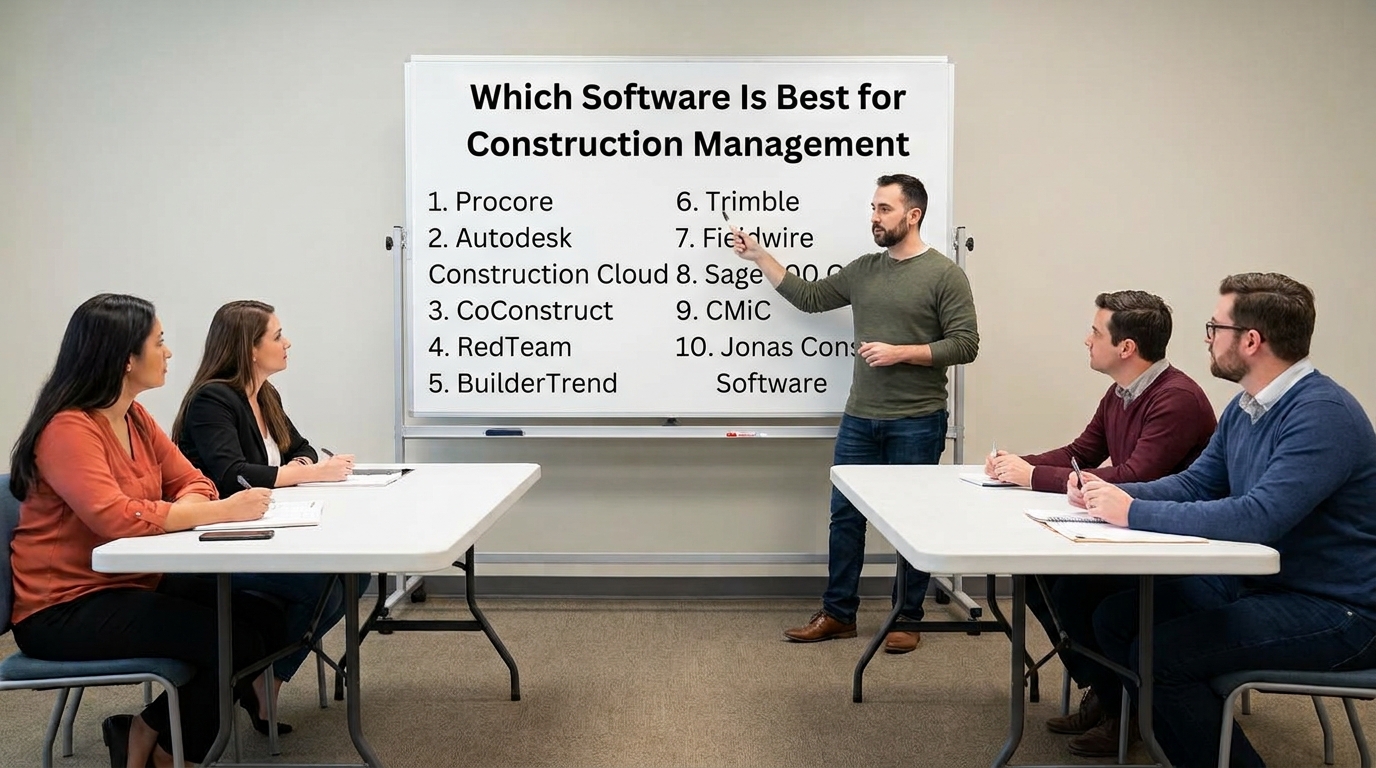
Short answer: Procore is one of the strongest overall choices for construction management, particularly for general contractors and organizations managing complex commercial projects. However, there is no single construction management platform that is best for every contractor.
Thank you for reading this post, don't forget to subscribe!Thank you for reading this post, don't forget to subscribe!Autodesk Forma can be especially attractive to teams already working heavily with Autodesk design and BIM workflows, while Buildertrend is strongly focused on residential builders and remodelers. Fieldwire is useful for field-first teams, while Contractor Foreman can suit smaller contractors looking for a broad collection of construction-management tools.
The right choice depends on your project size, construction type, field operations, scheduling, document control, estimating, financial management, accounting integrations and budget.
Quick Answer
Best overall construction management software: Procore
Best for Autodesk/BIM workflows: Autodesk Forma
Best for residential builders: Buildertrend
Best for field-focused teams: Fieldwire
Best for smaller contractors: Contractor Foreman
What Is Construction Management Software?
Construction management software is technology designed to help contractors, builders, owners, project managers and field teams plan, execute, monitor and close construction projects.
Unlike ordinary project-management software, construction management platforms are designed around construction-specific workflows.
Depending on the platform, these may include:
- Project scheduling
- Budget management
- Cost tracking
- Job costing
- Estimating
- Bid management
- Document management
- Construction drawings
- RFIs
- Submittals
- Daily logs
- Time tracking
- Change orders
- Safety management
- Quality management
- Field collaboration
- Client communication
- Financial management
The goal is to connect the job site, project manager, office, subcontractors, owners and financial team around the same project information.
What Is the Best Construction Management Software?
For a general-purpose construction management platform, Procore is one of the strongest overall choices in 2026.
Procore provides construction-specific capabilities covering areas such as preconstruction, project management, financial management, quality and safety, resource management and analytics. Its project-management platform also supports RFIs, submittals, drawings, field reporting, cost information and accounting integrations.
However, "best" should not be interpreted as "best for every construction company."
A residential builder may prefer Buildertrend. A team heavily invested in Autodesk's design ecosystem may prefer Autodesk Forma. A field-first contractor may prioritize Fieldwire.
That is why construction software should be selected according to the company's actual workflow rather than simply choosing the most recognizable brand.
Best Construction Management Software Compared
| Software | Best For | Key Strength |
|---|---|---|
| Procore | Commercial and complex construction | Comprehensive construction management |
| Autodesk Forma | BIM and Autodesk-connected teams | Design-to-construction connectivity |
| Buildertrend | Residential builders and remodelers | Residential project management |
| Fieldwire | Field teams | Plans, tasks and field coordination |
| Contractor Foreman | Small and mid-sized contractors | Broad construction-management functionality |
| Oracle Primavera | Large programs | Advanced scheduling and project controls |
| HCSS | Heavy civil contractors | Heavy civil and field operations |
Recent 2026 construction-software comparisons similarly identify Procore, Autodesk's construction platform, Buildertrend, Fieldwire, HCSS and Contractor Foreman among the leading options, although the ideal choice changes by contractor type.
1. Procore
Best overall for many commercial construction companies
Procore is built specifically for construction and provides a broad platform covering project execution from preconstruction through closeout.
Its capabilities include project management, bid management, budgeting, BIM, contract management, document control, financial management, resource tracking, RFIs and submittals.
Why contractors choose Procore
- Construction-specific workflows
- Project management
- Document control
- RFIs and submittals
- Budget and cost management
- Field reporting
- Construction drawings
- BIM capabilities
- Financial visibility
- Accounting integrations
Procore also supports construction-native AI capabilities designed to work with project information such as specifications, drawings, submittals and contracts.
Best suited for: general contractors, owners and construction organizations managing medium-to-large or complex projects.
Potential limitation: A smaller contractor may find an enterprise-oriented platform more extensive than necessary for simple residential projects.
2. Autodesk Forma
Best for Autodesk and BIM-connected construction workflows
Autodesk Construction Cloud has been incorporated into the Autodesk Forma portfolio, and Autodesk now describes the platform as a construction management environment connecting project teams, costs, schedules and project information.
This makes Autodesk Forma particularly relevant to organizations already using Autodesk products and BIM-centered workflows.
Key advantages include:
- Autodesk ecosystem integration
- BIM-connected workflows
- Construction collaboration
- Cost and schedule visibility
- Document management
- Design coordination
- Field and office collaboration
Best suited for: AEC organizations and contractors that want strong connections between design, BIM and construction execution.
3. Buildertrend
Best for residential builders and remodelers
Buildertrend focuses heavily on residential construction, including home builders, remodelers and specialty contractors.
Its platform includes project scheduling, daily logs, change orders, selections, submittals, time tracking, customer communication, financial management, estimates, invoices, bids and purchase orders.
Buildertrend says its platform is used by more than 20,000 builders and supports workflows spanning scheduling, financials and client communication.
Best suited for: residential builders, remodelers and contractors who need project management combined with client communication and financial workflows.
4. Fieldwire
Best for field-first construction teams
Fieldwire is designed around construction field operations and collaboration.
It can be particularly useful where supervisors, foremen and field workers need access to plans, tasks, punch lists, drawings and project information from mobile devices.
Best suited for: contractors that prioritize field coordination, task management and jobsite communication.
5. Contractor Foreman
Best for smaller and mid-sized contractors seeking broad functionality
Contractor Foreman is designed to bring many construction-management functions into one platform.
Depending on the plan and configuration, contractors can manage areas such as:
- Project management
- Scheduling
- Time tracking
- Safety
- Documents
- Estimates
- Invoices
- Daily logs
- Client communication
Best suited for: small and mid-sized contractors that want a broad construction-management system without necessarily implementing a large enterprise platform.
6. Oracle Primavera
Best for complex scheduling and large programs
Oracle Primavera is particularly well known for advanced construction scheduling and project controls.
It can be valuable for large infrastructure, engineering and construction programs where schedule management, dependencies, resource planning and project controls are critical.
Best suited for: large contractors, infrastructure projects and complex programs with sophisticated scheduling requirements.
7. HCSS
Best for heavy civil and infrastructure contractors
HCSS is particularly relevant to heavy civil contractors whose workflows differ from those of residential builders.
Heavy civil companies may need strong connections between estimating, field operations, equipment, labor and project financial information.
Best suited for: heavy highway, civil, infrastructure and field-intensive construction organizations.
What Features Should Construction Management Software Have?
The best construction management software should solve real problems between the field and office.
1. Scheduling
Construction schedules need to account for dependencies, crews, materials, subcontractors, inspections and changing site conditions.
2. Document management
Construction projects generate drawings, specifications, contracts, RFIs, submittals, meeting records, photos and other documents. A strong platform should make the current information easy to find.
3. Budget and cost management
Project managers need visibility into committed costs, actual costs, budgets and potential overruns.
4. Field reporting
Daily reports, photos, site observations, weather information, manpower and production records can provide important project history.
5. RFIs and submittals
RFIs and submittals are essential communication workflows on many commercial construction projects.
6. Change orders
Construction management software should make it easier to document, price, approve and track changes.
7. Time tracking
Labor information can be important for payroll, productivity and job costing.
8. Accounting integration
Project management should not operate as an isolated system. Connecting construction operations with accounting can improve financial visibility.
9. Mobile access
Construction teams spend much of their time away from the office. Mobile functionality is therefore critical.
10. Reporting
Management needs dashboards and reports that turn project data into actionable information.
Construction Management Software vs Project Management Software
These terms are sometimes used interchangeably, but they are not always identical.
| Feature | General Project Management | Construction Management |
|---|---|---|
| Task management | Yes | Yes |
| Scheduling | Yes | Construction-specific |
| Construction drawings | Limited | Yes |
| RFIs | Usually limited | Yes |
| Submittals | Usually limited | Yes |
| Job costing | Usually limited | Common |
| Change orders | Generic | Construction-specific |
| Field reporting | Limited | Core capability |
If your organization manages actual construction projects, construction-specific software can reduce the amount of customization required to reproduce industry workflows.
What Is the Best Construction Management Software for Small Contractors?
Small contractors do not necessarily need the same software as a large general contractor.
A smaller construction company may prioritize:
- Affordable pricing
- Simple setup
- Estimating
- Scheduling
- Time tracking
- Invoices
- Daily logs
- Customer communication
- Mobile access
Contractor Foreman, Buildertrend and other smaller-contractor-focused platforms may therefore be worth evaluating alongside larger platforms.
The key is to avoid paying for enterprise functionality that the company will never use.
What Is the Best Construction Management Software for Large Contractors?
Large contractors often need much deeper project controls.
Requirements can include:
- Multi-project management
- Advanced financial controls
- Document management
- RFIs and submittals
- BIM coordination
- Enterprise integrations
- Detailed reporting
- Resource management
- Advanced scheduling
- Audit trails
- Field-to-office connectivity
Platforms such as Procore, Autodesk Forma, UKG-related business systems, Oracle Primavera and other enterprise construction technologies may be considered depending on the organization's workflow.
What Is the Best Construction Management Software for Residential Construction?
Residential construction has different priorities from large commercial projects.
Home builders and remodelers often need strong capabilities for:
- Customer communication
- Selections
- Change orders
- Scheduling
- Estimates
- Invoices
- Daily logs
- Client portals
- Warranty management
Buildertrend is specifically positioned around residential construction and provides project, customer and financial features for builders and remodelers.
How Much Does Construction Management Software Cost?
Construction management software pricing varies substantially.
Some platforms publish subscription prices, while others use custom quotations based on company size, projects, users, modules and implementation requirements.
The total cost can include:
- Software subscription
- Number of users
- Number of projects
- Implementation
- Training
- Data migration
- Integrations
- Additional modules
- Support
Do not evaluate construction software solely on the monthly subscription price. A cheaper system that creates duplicate data entry can ultimately cost more in administrative time.
How to Choose the Best Construction Management Software
Step 1: Identify your construction type
Start by identifying whether you primarily perform residential, commercial, industrial, infrastructure, heavy civil or specialty construction.
Step 2: Map your current workflow
Document how estimating, scheduling, procurement, field reporting, RFIs, submittals, accounting and project closeout currently work.
Step 3: Identify the biggest problem
Do not buy software simply because it has hundreds of features. Identify the problem you are trying to solve.
For example:
- Too many paper documents?
- Poor field communication?
- Schedule delays?
- Weak cost visibility?
- Change orders getting lost?
- Labor not tracked correctly?
- Drawings getting out of date?
Step 4: Check integrations
Make sure the software can communicate with your accounting, payroll, estimating, BIM, scheduling and other systems.
Step 5: Test it on a real project
A software demonstration is not enough. Test the platform with actual project workflows before making a long-term commitment.
Step 6: Involve field staff
The best construction software is useless if supervisors, foremen and project managers do not actually use it.
Step 7: Calculate total cost of ownership
Include licensing, implementation, training, integrations and administrative time.
Top 5 Construction Management Software
If you want a shorter comparison rather than a broad list, see our dedicated guide:
What Are the Top 5 Construction Management Software?
That article can help readers who want to compare a smaller group of construction management platforms before going deeper into individual software options.
Top 10 Construction Management Software
For a broader market comparison, we also have a dedicated guide covering ten construction management software options.
What Are the Top 10 Construction Management Software?
This is useful when you want to expand the shortlist beyond the leading platforms discussed on this page.
Why Construction Management Software Matters
Construction projects involve many moving parts.
A typical project may include an owner, architect, engineer, general contractor, subcontractors, suppliers, consultants, inspectors and field workers.
Without a central system, information can become fragmented across:
- Spreadsheets
- Paper documents
- Messaging applications
- Shared drives
- Different accounting systems
- Separate scheduling tools
Construction management software attempts to bring these workflows into a connected environment.
The result can be better visibility into schedule, cost, documents, communication, field activity and project performance.
Frequently Asked Questions
Which software is best for construction management?
Procore is one of the strongest overall choices for construction management, particularly for general contractors managing complex commercial projects. However, the best platform depends on project type and business requirements.
What is the best construction management software for small contractors?
Smaller contractors should compare platforms such as Contractor Foreman, Buildertrend and other contractor-focused solutions based on price, ease of use, scheduling, estimating, field reporting and accounting needs.
What is the best construction management software for large contractors?
Large contractors may consider Procore, Autodesk Forma, Oracle Primavera and other enterprise construction platforms depending on project controls, BIM, scheduling, financial and collaboration requirements.
Is Procore the best construction management software?
Procore is one of the leading construction management platforms and is a strong overall option for many commercial construction organizations. It should not automatically be considered the best choice for every contractor because project type, company size and workflow requirements vary.
Is Autodesk Forma construction management software?
Yes. Autodesk's construction platform is now part of Autodesk Forma. Autodesk describes it as a construction management platform connecting teams and project information across design, planning and construction workflows.
What software do residential builders use?
Residential builders may use construction platforms such as Buildertrend and other residential-focused systems that provide scheduling, selections, change orders, customer communication, financial tools and daily project management.
Can construction management software handle payroll?
Some construction platforms integrate with payroll systems or provide time and labor capabilities, but construction management software should not automatically be assumed to replace specialized construction payroll software. Payroll may require tax processing, certified payroll, prevailing wage, union rules and other specialized capabilities.
Does construction management software include job costing?
Many construction management platforms provide budget and cost-management capabilities, while the depth of job costing varies by product. Contractors should verify how labor, materials, commitments, change orders and accounting data are handled before selecting a platform.
Related Construction Management Guides
Final Answer: Which Software Is Best for Construction Management?
Procore is one of the best overall construction management software choices for general contractors and complex commercial construction projects.
But that does not mean Procore is automatically the right solution for every construction company.
Autodesk Forma may be a better fit for organizations heavily invested in Autodesk and BIM workflows. Buildertrend is particularly relevant to residential builders and remodelers. Fieldwire can be attractive to field-first teams, while Contractor Foreman may suit smaller contractors seeking broad construction-management functionality.
The most important selection criteria are therefore not simply brand recognition or the number of features.
Look for software that connects your field operations, project management, schedule, documents, costs, communication and accounting in a way your team will actually use.
Bottom Line
For an overall construction-management platform, start by evaluating Procore, Autodesk Forma and Buildertrend, then expand the shortlist according to your construction type.
For smaller contractors, simplicity and total cost may matter more than enterprise functionality. For large commercial and infrastructure projects, project controls, financial visibility, BIM, document management and field-to-office connectivity become much more important.