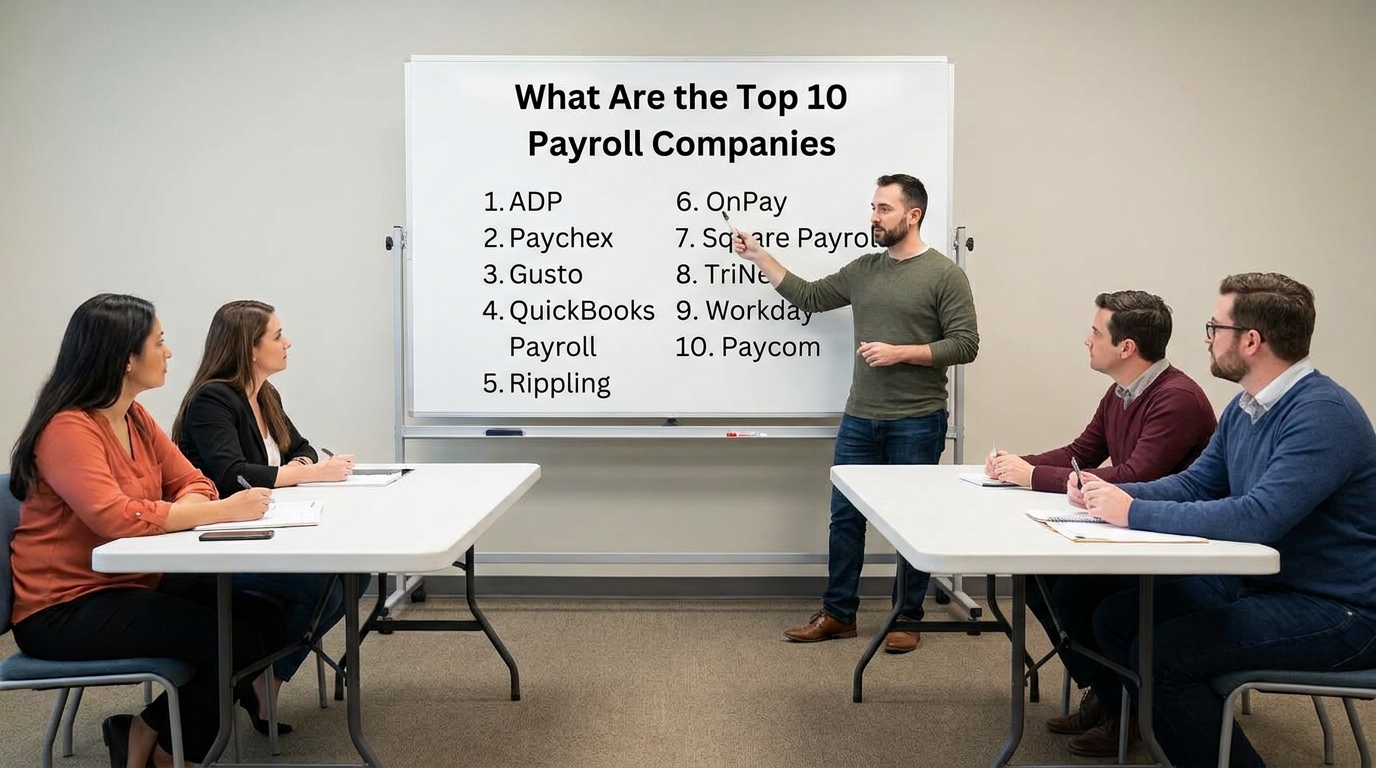
Short answer: The top payroll companies commonly considered by businesses in 2026 include ADP, Paychex, Paycor, UKG, Paylocity, Paycom, Gusto, QuickBooks Payroll, Workday and Rippling.
Thank you for reading this post, don't forget to subscribe!Thank you for reading this post, don't forget to subscribe!There is no single official ranking of the "top 10 payroll companies" because payroll providers serve different markets. Some focus on small businesses, while others specialize in mid-sized companies, large enterprises, global payroll, human capital management (HCM), or industry-specific payroll.
For example, ADP reports serving more than 1.1 million clients and paying more than 42 million workers across more than 140 countries and territories. Paychex reported approximately 840,000 total customers and approximately 800,000 payroll clients as of May 31, 2026.
The 10 Payroll Companies
- ADP
- Paychex
- Paycor
- UKG
- Paylocity
- Paycom
- Gusto
- QuickBooks Payroll
- Workday
- Rippling
What Are the Top 10 Payroll Companies in 2026?
The payroll industry includes traditional payroll processors, cloud payroll platforms and broader HCM providers.
The following companies represent some of the most recognizable payroll providers businesses may evaluate in 2026.
| Payroll Company | Best Known For | Typical Market |
|---|---|---|
| ADP | Payroll and HCM | Small business to enterprise |
| Paychex | Payroll and HR | Small and mid-sized businesses |
| Paycor | HCM and payroll | Small and mid-market |
| UKG | HCM and workforce management | Mid-market and enterprise |
| Paylocity | Payroll and HCM | Mid-market |
| Paycom | Integrated payroll and HR | Small to mid-market |
| Gusto | Small-business payroll | Small businesses |
| QuickBooks Payroll | Accounting-connected payroll | Small businesses |
| Workday | Enterprise HCM | Large organizations |
| Rippling | Payroll, HR and workforce IT | Growing businesses |
Important: The list above is a practical market comparison, not an official ranking from the payroll industry. A company's "top" provider depends on its size, location, workforce complexity, industry and required features.
1. ADP
ADP (Automatic Data Processing) is one of the largest and most established payroll and human capital management companies in the world.
ADP's 2026 annual report says the company serves more than 1.1 million clients and pays more than 42 million workers in more than 140 countries and territories. Its services extend beyond payroll into benefits administration, talent management, workforce management, compliance, HR and retirement services.
This broad footprint makes ADP relevant to companies ranging from small businesses to very large enterprises.
ADP is commonly used for:
- Payroll processing
- Payroll tax services
- Human resources
- Time and attendance
- Benefits administration
- Workforce management
- Compliance
- PEO services
- Enterprise HCM
- Global payroll requirements
ADP is also one of the most important competitors in the construction payroll market when contractors need payroll combined with HR, compliance and workforce management.
2. Paychex
Paychex is one of ADP's closest direct competitors.
Paychex's 2026 annual report states that it served approximately 840,000 total customers across the United States and parts of Europe, including approximately 800,000 payroll clients. The company describes ADP as its primary national competitor.
Paychex provides payroll, HR, benefits, insurance and broader HCM services.
Its payroll operation processed approximately $1.3 trillion in payroll volume during fiscal 2026, according to the company's annual report.
For businesses comparing ADP alternatives, Paychex is therefore one of the first providers worth investigating.
Read our related guide: Who Is ADP's Biggest Competitor?
3. Paycor
Paycor is an HCM platform offering payroll and human resources functionality for businesses with growing workforce-management needs.
Paycor is particularly relevant when a business wants more than payroll and needs additional HR capabilities around the employee lifecycle.
Paycor may be considered for:
- Payroll
- HR management
- Time tracking
- Benefits administration
- Talent management
- Workforce management
- Employee onboarding
Paycor is therefore more accurately viewed as an HCM provider with payroll at its core rather than simply a payroll-processing company.
4. UKG
UKG is a major human capital management and workforce-management provider.
UKG is particularly relevant for organizations with complex workforce requirements, including businesses that need payroll integrated with time, attendance, scheduling and broader workforce management.
UKG is commonly considered for:
- Payroll
- Workforce management
- Employee scheduling
- Time and attendance
- HR management
- Talent management
- Enterprise HCM
For larger employers, UKG can therefore compete with ADP as part of a broader HCM technology decision.
5. Paylocity
Paylocity provides cloud-based payroll and HCM services with a strong focus on integrated HR and workforce functions.
Businesses may consider Paylocity when they want payroll connected to areas such as HR, benefits, talent and workforce management.
Paylocity features may include:
- Payroll
- HR
- Benefits
- Time and labor management
- Talent management
- Employee experience tools
- Reporting and analytics
Paylocity is therefore particularly relevant to businesses that want payroll to become part of a broader HCM platform.
6. Paycom
Paycom is another major payroll and HCM provider.
Its platform combines payroll with HR and workforce-management functions, making it relevant to companies that want employees and HR teams to manage more workforce processes through a unified system.
Paycom can be considered by organizations looking for:
- Payroll processing
- HR management
- Time and attendance
- Talent management
- Expense management
- Employee self-service
- Workforce management
Its competitive overlap with ADP is therefore broader than payroll alone.
7. Gusto
Gusto is especially well known in the small-business payroll and HR market.
Compared with enterprise-oriented HCM systems, Gusto generally appeals to smaller organizations that want payroll and HR administration without implementing a highly complex enterprise platform.
Gusto is commonly considered for:
- Small-business payroll
- Payroll tax filing
- Employee onboarding
- Benefits
- Time tracking
- Basic HR administration
- Contractor payments
This makes Gusto an important competitor when a small business is deciding whether it needs a large provider such as ADP or a simpler payroll platform.
8. QuickBooks Payroll
QuickBooks Payroll is particularly relevant to businesses that already use QuickBooks for accounting.
The major advantage of an accounting-connected payroll system is the ability to keep payroll and financial information within the same broader software ecosystem.
QuickBooks Payroll may therefore be attractive to:
- Small businesses
- Contractors
- Professional service firms
- Businesses already using QuickBooks accounting
- Companies that want accounting and payroll closely connected
However, ADP and QuickBooks serve different needs at different levels of complexity.
For a detailed comparison, see: Is ADP or QuickBooks Better for Payroll?
9. Workday
Workday is primarily known for enterprise cloud applications covering human capital management, finance and related business processes.
Its payroll capabilities are therefore best understood within the broader enterprise HCM ecosystem.
Workday may be considered by large organizations that require:
- Enterprise HCM
- Payroll
- Human resources
- Talent management
- Workforce planning
- Analytics
- Large-scale employee management
For very large employers, the comparison may therefore be less about "payroll software" and more about choosing an entire enterprise HCM platform.
10. Rippling
Rippling combines payroll, HR and workforce technology with a broader approach to employee administration and IT management.
This makes it different from traditional payroll companies because the platform can connect workforce administration with technology and employee systems.
Rippling may be considered for:
- Payroll
- HR
- Employee onboarding
- Benefits
- Time tracking
- App and device management
- Workforce administration
Its position in the market makes it particularly relevant to technology-oriented businesses and growing companies looking for a more integrated workforce platform.
Top 10 Payroll Companies Compared
| Company | Payroll | HR/HCM | Best Fit |
|---|---|---|---|
| ADP | Yes | Extensive | Small business to enterprise |
| Paychex | Yes | Extensive | Small to mid-sized businesses |
| Paycor | Yes | Yes | Growing businesses |
| UKG | Yes | Extensive | Mid-market and enterprise |
| Paylocity | Yes | Yes | Mid-market |
| Paycom | Yes | Yes | Growing businesses |
| Gusto | Yes | Yes | Small businesses |
| QuickBooks Payroll | Yes | Some | Accounting-focused businesses |
| Workday | Yes | Extensive | Large enterprises |
| Rippling | Yes | Yes | Growing technology-focused businesses |
What Is the Most-Used Payroll Software?
If you are specifically looking for the most widely used payroll software rather than a general list of leading payroll companies, the answer requires a different methodology.
Customer count, employees paid, revenue, geographic coverage and payroll-processing volume can produce very different rankings.
For example, ADP reports more than 1.1 million clients and more than 42 million workers paid globally, while Paychex reports approximately 800,000 payroll clients.
For a deeper answer to this specific question, read:
Which Payroll Company Is Best for Small Businesses?
Small businesses generally do not need the same payroll infrastructure as multinational corporations.
Depending on requirements, small businesses may compare:
- Gusto
- QuickBooks Payroll
- Paychex
- ADP
- Paycor
- Rippling
The most important factors include ease of use, payroll tax filing, employee onboarding, benefits, accounting integration, support and total cost.
A small business should also consider how likely its payroll requirements are to become more complicated as the company grows.
Which Payroll Companies Are Best for Large Businesses?
Large organizations typically need more than basic payroll processing.
They may require:
- Advanced HCM
- Global payroll
- Workforce management
- Benefits administration
- Compliance management
- Advanced reporting
- Employee self-service
- Talent management
- Enterprise integrations
- Complex organizational structures
For these organizations, providers such as ADP, UKG and Workday can become part of a broader enterprise technology decision.
What Are the Top Payroll Companies for Construction?
Construction payroll is different from ordinary office payroll.
A contractor may need to process payroll while simultaneously tracking labor by:
- Project
- Job site
- Phase
- Cost code
- Employee classification
- Union
- Pay rate
- Overtime category
Construction companies may also need certified payroll reporting, prevailing wage calculations, union requirements, time tracking and integration with construction accounting or job-costing systems.
Therefore, the largest payroll company is not automatically the best construction payroll provider.
A construction company should evaluate whether its payroll system can connect labor costs to the projects where the work was performed.
This is one reason construction payroll software deserves its own category rather than simply being treated as ordinary small-business payroll.
ADP vs Paychex vs QuickBooks Payroll
These three providers frequently appear in payroll comparisons, but they serve somewhat different needs.
| Factor | ADP | Paychex | QuickBooks Payroll |
|---|---|---|---|
| Payroll | Yes | Yes | Yes |
| HR | Extensive | Extensive | Available |
| Accounting integration | Yes | Yes | Strong QuickBooks integration |
| Enterprise focus | Strong | Available | Limited compared with enterprise HCM platforms |
| Small business | Yes | Yes | Strong fit |
For a detailed comparison, see Is ADP or QuickBooks Better for Payroll?
How to Choose a Payroll Company
Instead of choosing a payroll company simply because it appears on a "top 10" list, evaluate the following factors.
1. Employee count
Determine how many employees you have today and how many you expect to have in the future.
2. Payroll complexity
Consider overtime, bonuses, deductions, multiple pay rates, different locations and employee classifications.
3. Tax compliance
Check how payroll taxes are calculated, filed and paid and which jurisdictions are supported.
4. HR requirements
If you need onboarding, benefits, employee records, performance management or other HR functions, compare the HCM capabilities as well as payroll.
5. Integrations
Check whether the payroll platform integrates with your accounting, time tracking, ERP, benefits and other business systems.
6. Industry requirements
Construction companies, healthcare organizations, restaurants and other industries can have payroll requirements that ordinary payroll software does not fully address.
7. Total cost
Do not compare only the advertised base price. Consider employee fees, payroll-run fees, tax services, HR modules, implementation and optional integrations.
8. Scalability
Choose a platform that can continue supporting the organization as its workforce and payroll complexity increase.
Top 10 Payroll Companies: Frequently Asked Questions
What are the top 10 payroll companies?
Ten major payroll companies commonly considered by businesses in 2026 are ADP, Paychex, Paycor, UKG, Paylocity, Paycom, Gusto, QuickBooks Payroll, Workday and Rippling.
What is the largest payroll company?
ADP is one of the largest global payroll and HCM providers. Its 2026 annual report says it serves more than 1.1 million clients and pays more than 42 million workers in more than 140 countries and territories.
What is the most-used payroll software?
The answer depends on whether you measure customer count, employees paid, payroll volume or another metric. ADP and Paychex are among the largest payroll providers by customer and workforce reach. Paychex reported approximately 800,000 payroll clients in 2026.
See our dedicated guide: What Is the Most-Used Payroll Software?
Who is ADP's biggest competitor?
Paychex is generally considered ADP's closest direct competitor in traditional U.S. payroll and HR services. Paychex identifies ADP as its primary national competitor in its 2026 annual report.
Read more: Who Is ADP's Biggest Competitor?
Is QuickBooks Payroll one of the top payroll companies?
QuickBooks Payroll is an important payroll option, particularly for small businesses that already use QuickBooks accounting. Its relevance is strongest where accounting and payroll integration is a priority.
What are the top payroll companies for construction?
Construction companies should evaluate payroll providers based on job costing, field time tracking, certified payroll, prevailing wage, union payroll, labor classifications and accounting integrations rather than company size alone.
What are the top HR software companies?
Payroll and HR software overlap significantly. However, a payroll provider is not automatically the best HR platform. Businesses should compare payroll, HCM, workforce management, benefits, talent and employee-management capabilities separately.
See our related guide: What Are the Top 5 HR Software?
Related Payroll and HR Guides
Final Answer: What Are the Top 10 Payroll Companies?
The top payroll companies worth considering in 2026 include:
- ADP
- Paychex
- Paycor
- UKG
- Paylocity
- Paycom
- Gusto
- QuickBooks Payroll
- Workday
- Rippling
There is no single best payroll company for every organization. ADP and Paychex have enormous payroll footprints, while providers such as UKG and Workday are especially relevant to broader enterprise HCM requirements. Gusto and QuickBooks Payroll are important options for smaller businesses, while Paylocity, Paycor, Paycom and Rippling serve various growing-business and mid-market needs.
For construction companies, however, the decision should go beyond company size and brand recognition. Job costing, time tracking, certified payroll, prevailing wage, union requirements and construction accounting integration can be decisive.
Bottom Line
The top 10 payroll companies are not necessarily ranked from best to worst. The right provider depends on your workforce size, payroll complexity, industry, budget, compliance requirements and accounting ecosystem.
For contractors, start with payroll requirements specific to construction before choosing a general payroll platform.