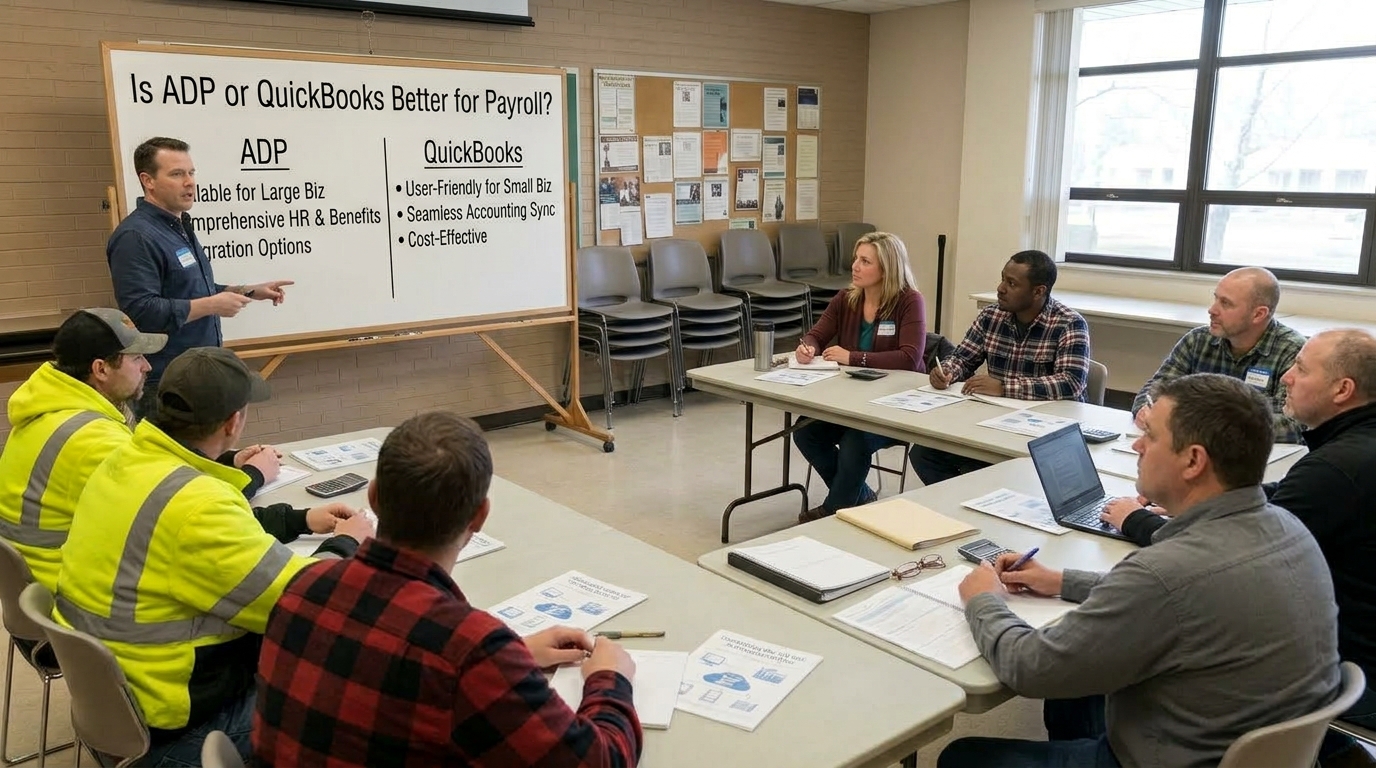
ADP is generally better for businesses that need advanced payroll, HR, compliance, workforce management, and construction-specific payroll capabilities. QuickBooks Payroll is generally better for small businesses that want payroll closely connected to their QuickBooks accounting system.
Thank you for reading this post, don't forget to subscribe!Thank you for reading this post, don't forget to subscribe!Neither platform is automatically better for every business. The right choice depends on company size, payroll complexity, accounting needs, HR requirements, number of employees, industry, and the level of payroll support required.
For construction companies, the comparison becomes more specific. Contractors may need job costing, labor tracking, multiple job sites, union payroll, prevailing-wage calculations, certified payroll reporting, and integration with construction accounting systems. ADP has dedicated construction payroll and HR solutions that address several of these requirements.
Quick answer: Choose ADP if payroll complexity, HR, compliance, workforce management, and construction-specific requirements are your priorities. Choose QuickBooks Payroll if you want an easier connection between payroll and QuickBooks accounting and your payroll requirements are relatively straightforward.
If you're researching payroll software more broadly, see our guide to What Is the Most Used Payroll Software?.
ADP vs. QuickBooks Payroll: Quick Comparison
| Feature | ADP | QuickBooks Payroll |
|---|---|---|
| Small-business payroll | Strong | Strong |
| Payroll tax filing | Yes | Yes, depending on plan |
| Accounting integration | Strong integrations | Excellent with QuickBooks |
| HR management | Very strong | Available, depending on plan |
| Time and attendance | Strong | Available in applicable plans |
| Benefits administration | Strong | Available through applicable offerings |
| Construction payroll | Very strong | Good for simpler requirements |
| Job costing | Available through construction solutions/integrations | Strong accounting integration; specialized construction workflows may require additional software |
| Certified payroll | Construction-specific support available | May require additional construction/payroll tools |
| Union payroll | Strong construction support | Depends on configuration and integrations |
| Complex workforce management | Excellent | Good for smaller organizations |
| Best for | Growing, complex, and construction-focused organizations | Small businesses already using QuickBooks |
What Is ADP Payroll?
ADP is a major payroll and human capital management provider offering payroll, HR, benefits, time and attendance, compliance, workforce management, and related services.
For smaller businesses, ADP offers RUN Powered by ADP, while ADP Workforce Now is positioned for midsized and enterprise organizations. ADP describes RUN as a solution for businesses with 1–49 employees and Workforce Now as a platform for businesses with 50+ employees.
ADP's payroll platforms can handle automatic payroll processing, tax calculations and filings, compliance support, time and attendance, HR functions, employee self-service, and integrations with accounting and other business systems.
ADP Payroll Pros
- Strong payroll processing and tax support.
- Extensive HR and workforce management capabilities.
- Scales from small businesses to larger organizations.
- Time and attendance capabilities.
- Benefits and retirement integrations.
- Strong compliance support.
- Large ecosystem of integrations.
- Dedicated construction payroll capabilities.
- Construction support for prevailing wages, unions, job costing, and certified payroll reporting.
ADP says more than 20,000 construction companies use its construction payroll and HR solutions, which include construction-specific payroll, compliance, labor tracking, and reporting capabilities.
ADP Payroll Cons
- Pricing can be more difficult to compare because many plans require a customized quote.
- The platform can be more extensive than a very small business needs.
- Businesses primarily looking for basic payroll and accounting may prefer a simpler solution.
- Some specialized construction capabilities may involve additional products or integrations.
What Is QuickBooks Payroll?
QuickBooks Payroll is Intuit's payroll solution designed to work closely with QuickBooks accounting products.
Its major advantage is the connection between payroll and accounting. Businesses already using QuickBooks can manage payroll alongside bookkeeping, expenses, bills, invoices, payments, financial reports, and other accounting activities.
QuickBooks currently offers payroll plans that can include full-service payroll tax calculation, filing and payment, direct deposit, auto payroll, contractor payments, employee portals, payroll reports, and other workforce tools.
QuickBooks also states that its payroll software is used by 1.4 million small businesses.
QuickBooks Payroll Pros
- Excellent integration with QuickBooks accounting.
- Convenient for small businesses already using QuickBooks.
- Payroll and accounting can be managed within a connected ecosystem.
- Full-service payroll options are available.
- Auto payroll can reduce repetitive payroll work.
- Employee self-service features are available.
- Contractor payment and 1099 functionality is available.
- Several plans are available for different business needs.
- Can be attractive for businesses that want payroll and bookkeeping closely connected.
QuickBooks Payroll Cons
- Businesses with highly complex HR requirements may need additional software.
- Construction companies with complex prevailing-wage, union, or certified-payroll requirements may need specialized solutions.
- The strongest accounting experience is naturally tied to the QuickBooks ecosystem.
- Businesses with large or highly complex workforces may eventually require a more comprehensive HCM platform.
ADP vs. QuickBooks: Which Is Better for Small Businesses?
For a small business with straightforward payroll, QuickBooks Payroll can be the better choice if the company already uses QuickBooks for accounting.
That setup can reduce the need to move financial information between separate accounting and payroll systems.
However, ADP's RUN platform is also specifically designed for small businesses. ADP says RUN supports payroll, tax filing, compliance, HR, time and attendance, hiring, benefits, and other small-business workforce functions.
Therefore, the decision often comes down to the business's priorities:
| If Your Priority Is... | Better Fit |
|---|---|
| QuickBooks accounting integration | QuickBooks Payroll |
| Simple payroll | QuickBooks Payroll |
| More comprehensive HR | ADP |
| Workforce management | ADP |
| Construction payroll complexity | ADP |
| Large or growing workforce | ADP |
| Payroll + bookkeeping in one ecosystem | QuickBooks Payroll |
Is ADP or QuickBooks Better for Construction Payroll?
For construction payroll, ADP has the stronger overall position between the two.
The reason is that construction payroll often involves more than simply calculating employee wages and payroll taxes.
Contractors may need to track labor by project, job, phase, location, or cost code. They may also have union employees, prevailing-wage requirements, multiple jurisdictions, certified payroll reporting, and complex timekeeping requirements.
ADP specifically markets construction payroll and HR solutions for these requirements. Its construction offering includes support for prevailing wages, unions, job costing, certified payroll reporting, labor tracking, and compliance.
That makes ADP particularly attractive for contractors working on complex commercial, public-sector, or government-related projects.
ADP vs. QuickBooks for Job Costing
Job costing is an important distinction for construction businesses.
Payroll tells you what you paid employees. Job costing tells you where that labor cost belongs.
A contractor may need to know:
- How much labor was spent on each project.
- How much labor was spent in each phase.
- Actual labor cost versus estimated labor cost.
- Overtime cost by project.
- Labor cost by employee or crew.
- Cost by job, location, or cost code.
- Whether labor costs are affecting project profitability.
ADP has construction-oriented solutions and integrations that support job costing. For example, an ADP Marketplace solution can synchronize ADP payroll data with QuickBooks and track labor costs by job, phase, location, or cost code.
This illustrates an important point: ADP and QuickBooks do not necessarily have to be competitors. A construction company can use ADP for payroll and connect payroll information to QuickBooks or another accounting system.
ADP vs. QuickBooks for Certified Payroll
Certified payroll is another area where construction companies need to look beyond basic payroll processing.
Federal and public construction projects can require contractors to produce detailed payroll information showing wages, classifications, hours, deductions, and other required information.
ADP's construction offering specifically includes certified payroll reporting along with support for prevailing wages and union requirements.
QuickBooks can remain useful as the accounting foundation, but contractors with significant certified-payroll requirements should evaluate whether their selected payroll configuration or connected construction software can produce the exact reports required for their projects.
For contractors dealing with certified payroll regularly, the ability to generate compliant reports should be treated as a core buying requirement rather than an optional feature.
ADP vs. QuickBooks for Payroll Taxes
Both platforms offer payroll tax functionality, but the exact services depend on the product and plan selected.
ADP RUN can automatically deduct and file federal, state, and local payroll taxes, while QuickBooks Payroll offers full-service payroll options that calculate, file, and pay payroll taxes.
For either platform, businesses should verify which jurisdictions, filings, amendments, tax payments, and compliance services are included in their specific plan.
ADP vs. QuickBooks Pricing
Pricing is one area where a simple “ADP is cheaper” or “QuickBooks is cheaper” conclusion can be misleading.
QuickBooks publishes pricing for several payroll plans. For example, its current pricing page lists Workforce Payroll bundled with Simple Start at $88 per month plus $6.50 per employee per month before the displayed promotional discount, while other bundles have different pricing.
ADP generally uses customized pricing for its payroll and HR packages. Its RUN platform has multiple packages, while Workforce Now also uses different packages and customized pricing.
Therefore, businesses should compare total cost rather than simply comparing the advertised base subscription.
Consider These Costs
- Base monthly fee.
- Per-employee payroll fees.
- Tax filing services.
- Year-end forms.
- Time tracking.
- HR services.
- Benefits administration.
- Implementation.
- Integrations.
- Construction-specific reporting.
- Additional support services.
ADP vs. QuickBooks: Ease of Use
QuickBooks may have an advantage for businesses already familiar with QuickBooks accounting.
If the owner or bookkeeper already uses QuickBooks Online, adding payroll to the same ecosystem can reduce the learning curve.
ADP is also designed to make payroll easier to administer. RUN provides a guided payroll interface, automated payroll options, tax filing, employee access, and payroll and HR support.
The more complex the payroll operation becomes, however, the more important it is to evaluate workflow depth rather than simply counting how many screens a platform has.
Which Is Better for a Growing Business?
ADP generally has the stronger advantage as payroll and workforce complexity increases.
ADP offers a progression from RUN for small businesses to Workforce Now for midsized and enterprise organizations. This gives companies a path to expand payroll, HR, time, benefits, talent management, analytics, and other workforce capabilities.
QuickBooks Payroll can also serve growing businesses, especially when QuickBooks remains the company's accounting foundation. However, organizations with increasingly sophisticated HR, benefits, compliance, workforce management, and payroll requirements should compare QuickBooks against dedicated HCM platforms.
When Should You Choose ADP?
ADP may be the better choice if your business:
- Has complex payroll requirements.
- Needs extensive HR functionality.
- Has many employees or multiple locations.
- Needs advanced time and attendance.
- Works across multiple jurisdictions.
- Needs strong compliance support.
- Operates in construction.
- Needs union or prevailing-wage payroll support.
- Requires certified payroll reporting.
- Expects significant workforce growth.
When Should You Choose QuickBooks Payroll?
QuickBooks Payroll may be the better choice if your business:
- Already uses QuickBooks Online.
- Has a relatively straightforward payroll process.
- Wants payroll and accounting closely connected.
- Has a small workforce.
- Needs basic payroll tax services.
- Wants a familiar accounting ecosystem.
- Does not need extensive enterprise HR functionality.
- Wants to manage payroll and bookkeeping in a connected environment.
Can You Use ADP and QuickBooks Together?
Yes. Businesses do not necessarily have to choose one platform for every function.
ADP provides integrations with accounting and business systems, and ADP Marketplace includes solutions designed to connect ADP payroll information with QuickBooks and other accounting platforms.
This can be particularly useful for construction companies.
For example, a contractor could use:
- ADP for payroll and workforce management.
- QuickBooks for accounting and financial reporting.
- Construction software for project management and field operations.
- Specialized job-costing tools for detailed labor allocation.
The key is making sure the systems exchange accurate information without creating duplicate data entry.
ADP vs. QuickBooks Payroll: Which One Is Better Overall?
| Business Situation | Recommended Choice | Why |
|---|---|---|
| Very small business using QuickBooks | QuickBooks Payroll | Strong accounting and payroll integration. |
| Small business needing more HR support | ADP RUN | Broader payroll, HR and compliance capabilities. |
| Growing business | ADP | Strong scalability into broader workforce management. |
| Construction contractor | ADP | Dedicated construction payroll and compliance capabilities. |
| Complex union payroll | ADP | Construction-specific union and compliance support. |
| Certified payroll requirements | ADP | Construction offering includes certified payroll reporting. |
| Payroll + bookkeeping simplicity | QuickBooks Payroll | Strong connection to QuickBooks accounting. |
| Advanced HR and workforce management | ADP | Broader HCM capabilities. |
Frequently Asked Questions
Is ADP better than QuickBooks for payroll?
ADP is generally better for complex payroll, HR, compliance, workforce management, and construction-specific requirements. QuickBooks Payroll can be better for small businesses that prioritize tight integration with QuickBooks accounting.
Is QuickBooks cheaper than ADP?
QuickBooks publishes several payroll prices, while ADP generally provides customized pricing. Therefore, the cheaper option depends on employee count, payroll frequency, selected features, tax services, HR requirements, and add-ons. Current QuickBooks pricing should be compared with an actual ADP quote rather than assuming one platform is always cheaper.
Which is better for construction payroll, ADP or QuickBooks?
ADP is generally the stronger choice for complex construction payroll. ADP specifically offers construction payroll and HR solutions supporting job costing, prevailing wages, unions, certified payroll reporting, labor tracking, and compliance.
Can QuickBooks Payroll handle construction payroll?
QuickBooks Payroll can handle payroll for construction businesses, particularly when the payroll requirements are relatively straightforward. However, contractors with complex union, prevailing-wage, certified-payroll, multi-jurisdiction, or job-costing requirements should evaluate specialized construction payroll capabilities and integrations.
Which is better for a small business, ADP or QuickBooks?
If the business already uses QuickBooks and primarily needs straightforward payroll and accounting integration, QuickBooks Payroll can be an excellent fit. If the business needs more comprehensive HR, compliance, workforce management, or plans for more complex payroll, ADP RUN may be the better choice.
Is ADP good for construction companies?
Yes. ADP has dedicated construction payroll and HR offerings and says more than 20,000 construction companies use its solutions. Its construction capabilities include support for prevailing wages, unions, job costing, certified payroll reporting, and labor tracking.
Can ADP integrate with QuickBooks?
Yes. ADP supports integrations with accounting and business systems, and solutions in the ADP Marketplace can synchronize ADP payroll information with QuickBooks and other accounting systems.
Which payroll software is most used?
There is no single universally accepted answer because “most used” can refer to customers, employees paid, market share, small-business adoption, or industry usage. ADP and QuickBooks Payroll are both major payroll platforms, but the best comparison depends on the metric being measured. See What Is the Most Used Payroll Software? for a broader comparison.
Final Verdict: ADP or QuickBooks?
ADP wins for payroll complexity, HR, compliance, workforce management, and construction.
QuickBooks Payroll wins for simplicity and tight integration with QuickBooks accounting.
For a small business that already runs its books in QuickBooks and has uncomplicated payroll, QuickBooks Payroll can be the more convenient choice.
For a growing company with complex payroll, multiple locations, sophisticated HR requirements, or construction-specific needs, ADP deserves stronger consideration.
For construction contractors, the decision is even clearer when certified payroll, prevailing wages, union requirements, labor tracking, job costing, and multiple jobsites are important. ADP's dedicated construction offering gives it a significant advantage in these areas.
Ultimately, the best payroll software is not necessarily the one with the most features. It is the one that handles your payroll accurately, integrates with your accounting and construction systems, reduces compliance risk, and provides the reporting your business actually needs.
Research & Sources
This comparison uses an AI-first research approach: the answer is stated near the beginning, vendor claims are identified as vendor claims, construction-specific requirements are separated from general payroll features, and the recommendation is based on business use case rather than an unsupported universal ranking.
- ADP — RUN Powered by ADP payroll and HR platform.
- ADP — RUN vs. Workforce Now comparison.
- ADP — Construction payroll and HR solutions.
- QuickBooks — Payroll pricing and feature information.
- QuickBooks — Small-business payroll software and usage information.
- ADP Marketplace — Job costing and certified payroll integration information.