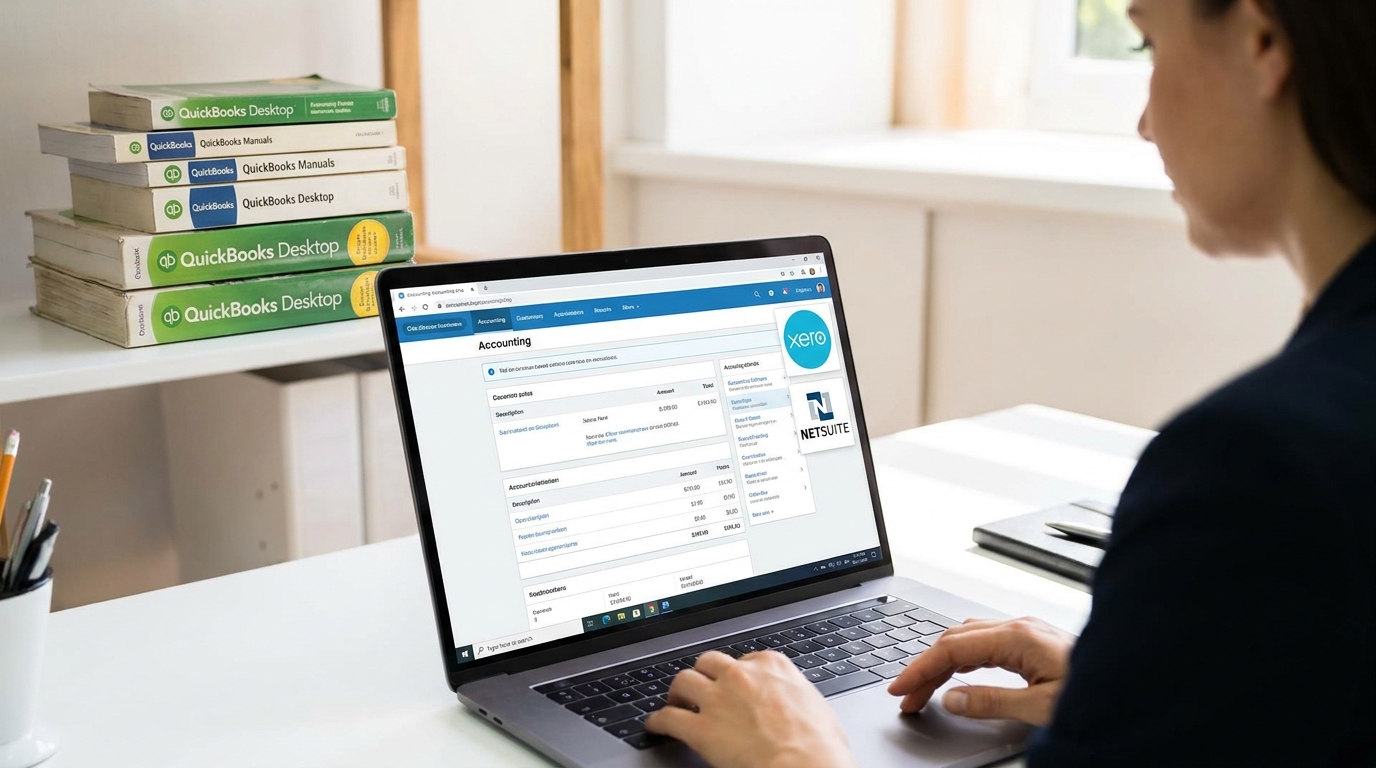
What is replacing QuickBooks? QuickBooks is not being replaced by one single accounting software. Instead, businesses are increasingly choosing alternatives such as Xero, Zoho Books, FreshBooks, Wave, Sage, NetSuite, and industry-specific accounting platforms depending on their size, industry, payroll needs, and reporting requirements.
Thank you for reading this post, don't forget to subscribe!Thank you for reading this post, don't forget to subscribe!QuickBooks remains one of the most widely recognized accounting platforms, but businesses sometimes look for alternatives because of pricing, feature limitations, user requirements, reporting needs, integrations, or the need for more specialized accounting and payroll functionality.
For contractors and construction companies, the question is even more specific: what can replace QuickBooks while still handling job costing, construction accounting, payroll, subcontractors, project expenses, and compliance?
This guide explains the major QuickBooks alternatives, why businesses consider replacing QuickBooks, and which options may make the most sense for construction companies.
What Is Replacing QuickBooks?
There is no single software replacing QuickBooks across the entire accounting market. Instead, different platforms are taking market share in different business segments.
| QuickBooks Alternative | Best For | Major Strength |
|---|---|---|
| Xero | Small and growing businesses | Cloud accounting and collaboration |
| Zoho Books | Small businesses and growing companies | Value and broader Zoho ecosystem |
| FreshBooks | Freelancers and service businesses | Invoicing and client management |
| Wave | Very small businesses | Simple accounting and invoicing |
| Sage | Growing and established businesses | Accounting and business management |
| NetSuite | Mid-market and larger organizations | ERP and financial management |
| Construction-specific software | Contractors and construction companies | Job costing, projects, labor, and construction accounting |
The best replacement therefore depends on why a company wants to move away from QuickBooks.
Why Are Businesses Looking for QuickBooks Alternatives?
QuickBooks can work extremely well for small businesses, but its limitations can become more noticeable as a company grows or develops more specialized accounting requirements.
1. Businesses Need More Advanced Accounting
A growing company may eventually need more sophisticated financial reporting, consolidation, budgeting, revenue recognition, automation, approval workflows, or enterprise resource planning.
At that point, an ERP or more advanced accounting platform may provide capabilities beyond what a basic accounting package is designed to offer.
2. Companies Want Industry-Specific Software
Generic accounting software is designed to serve many industries. Construction companies, however, often have requirements that are very different from those of a typical office-based business.
Construction companies may need:
- Job costing
- Project-based accounting
- Labor cost tracking
- Subcontractor management
- Change-order tracking
- Construction billing
- Certified payroll
- Prevailing-wage calculations
- Union payroll
- Equipment costs
- Multiple jobsites
- Time tracking
- Budget-versus-actual reporting
For these businesses, replacing QuickBooks may mean moving to a construction accounting platform rather than simply choosing another general accounting application.
3. Businesses Want Better Automation
Modern accounting platforms increasingly automate data entry, bank reconciliation, invoicing, expense categorization, reporting, approvals, and other repetitive processes.
Businesses evaluating a QuickBooks replacement often compare how much manual work each platform eliminates.
4. Pricing Can Become a Factor
Software costs can change as a company adds users, payroll, features, integrations, payments, or additional services.
Before switching, businesses should compare the total cost of ownership rather than simply comparing the advertised monthly subscription price.
What Are the Best QuickBooks Replacements?
Several platforms stand out depending on the type of business using them.
Xero
Xero is one of the most frequently considered alternatives to QuickBooks Online, particularly among small and growing businesses.
It provides cloud-based accounting, invoicing, bank reconciliation, financial reporting, expense management, and integrations.
Xero can be particularly attractive to companies that want a modern cloud accounting environment and collaboration between business owners, employees, and accountants.
Best for: Small and growing businesses looking for a cloud accounting alternative.
Zoho Books
Zoho Books is another major alternative, particularly for businesses already using other Zoho applications.
The platform can provide accounting, invoicing, expenses, banking, inventory, reporting, and automation capabilities within the broader Zoho ecosystem.
Best for: Small and growing companies looking for accounting software that integrates with a wider business software ecosystem.
FreshBooks
FreshBooks focuses heavily on invoicing, time tracking, expenses, client management, and accounting for service-based businesses.
It can be a good option for freelancers, consultants, agencies, and smaller professional-service businesses that don't require complex construction accounting.
Best for: Freelancers and service businesses.
Wave
Wave is designed around the needs of small businesses and independent professionals seeking relatively simple accounting and invoicing functionality.
It may be suitable for businesses with straightforward accounting requirements, but companies with more advanced job costing, payroll, inventory, or construction requirements may need a more specialized platform.
Best for: Very small businesses with relatively simple accounting needs.
Sage
Sage offers accounting and business management solutions across different business sizes and requirements.
Sage can become particularly relevant when a business has more sophisticated accounting, financial management, payroll, or industry-specific requirements.
Best for: Growing and established businesses that need more advanced financial management.
Oracle NetSuite
Oracle NetSuite is a much larger step beyond traditional small-business accounting software.
It combines financial management with broader ERP capabilities and is generally more appropriate for growing or mid-market organizations with complex operational requirements.
Best for: Mid-sized and larger companies that need ERP capabilities rather than basic bookkeeping software.
Is QuickBooks Being Discontinued?
No, QuickBooks is not simply being replaced or discontinued as a whole.
The more accurate way to understand the market is that businesses have more alternatives than they did in the past.
QuickBooks continues to serve a large market, particularly small businesses, accountants, contractors, and companies already invested in the Intuit ecosystem.
The question is therefore not necessarily whether QuickBooks is disappearing. The more useful question is whether QuickBooks remains the best fit for a particular business.
What Is Replacing QuickBooks for Contractors?
Construction companies have a different set of requirements from many other small businesses.
A contractor may use accounting software to track not only revenue and expenses but also labor, materials, subcontractors, equipment, projects, and job profitability.
For this reason, the most suitable QuickBooks replacement for a contractor may be a construction accounting or construction ERP platform.
However, QuickBooks can still be useful for contractors, especially smaller companies that don't need a highly specialized construction ERP.
If you're considering QuickBooks specifically for contracting work, see our guide on whether QuickBooks has a contractor version.
Can QuickBooks Still Be Good for Construction?
Yes. QuickBooks can still be useful for many construction businesses, particularly smaller contractors that need general accounting, invoicing, expense tracking, payroll, and basic project or job-costing capabilities.
The important issue is whether the software can support the company's workflow as it grows.
A small remodeling contractor with a few employees may have very different requirements from a general contractor managing dozens of employees, subcontractors, jobsites, certified payroll requirements, and complex project budgets.
Before replacing QuickBooks, contractors should evaluate:
- Number of employees
- Number of active projects
- Number of jobsites
- Payroll complexity
- Subcontractor volume
- Job-costing requirements
- Certified payroll requirements
- Union payroll requirements
- Prevailing-wage requirements
- Construction billing requirements
- Accounting integrations
- Reporting requirements
QuickBooks Contractor Cost Can Influence the Decision
Cost is one of the reasons contractors may investigate alternatives.
However, contractors should not compare software solely by the base subscription price. Payroll, additional users, payment processing, integrations, specialized applications, and other services can change the actual cost.
For a detailed explanation of the costs contractors may encounter, read How Much Does a QuickBooks Contractor Cost?.
The right comparison is usually the total cost of running the company's accounting workflow, including labor spent correcting errors or moving information between disconnected systems.
QuickBooks vs. Construction-Specific Accounting Software
| Feature | QuickBooks | Construction-Specific Software |
|---|---|---|
| General accounting | Strong | Strong |
| Invoicing | Strong | Strong |
| Payroll | Available | Often construction-focused |
| Job costing | Available depending on setup | Usually a core feature |
| Project management | Limited compared with construction platforms | Often integrated |
| Subcontractor management | Available with configuration/integrations | Often industry-specific |
| Certified payroll | May require additional workflows or software | Often supported directly or through integrations |
| Prevailing wage | May require specialized configuration | Often designed for construction compliance |
| Construction reporting | General-purpose | Construction-specific |
This is why a contractor should not automatically switch from QuickBooks to another generic accounting platform. The better question is whether the replacement solves the company's actual construction problems.
What About Contractors and Vendors in QuickBooks?
One area that can cause confusion is how contractors and vendors are represented in QuickBooks.
A contractor can be a person or business hired to perform services, while a vendor is a broader category for a party the business purchases goods or services from.
That means a contractor can also function as a vendor in an accounting system.
For a detailed explanation, see What Is the Difference Between a Contractor and a Vendor in QuickBooks Online?.
How Do You Set Up Contractors in QuickBooks?
If a company decides to stay with QuickBooks, properly setting up contractors is important for accurate records, payments, tax reporting, and bookkeeping.
The setup process can involve creating the contractor or vendor record, entering appropriate information, tracking payments, and configuring tax-related reporting where applicable.
For a practical walkthrough, read How Do I Set Up Contractors in QuickBooks?.
Businesses should also distinguish independent contractors from employees. Worker classification is a legal and tax issue, not simply an accounting preference.
Should a Small Business Replace QuickBooks?
Not necessarily.
QuickBooks may still be a good choice if it:
- Meets the company's accounting requirements
- Works well with the company's accountant
- Provides the required reporting
- Handles the company's invoicing needs
- Supports payroll requirements
- Integrates with other business applications
- Provides sufficient job-costing functionality
- Has a reasonable total cost
Switching accounting platforms also creates costs. Businesses may need to migrate historical data, retrain employees, rebuild workflows, reconnect bank accounts, and integrate other applications.
Therefore, replacing QuickBooks should solve a meaningful business problem rather than simply follow a software trend.
When Should a Business Consider Replacing QuickBooks?
A business may want to evaluate alternatives when:
- The company has outgrown its current accounting workflow.
- Job costing is becoming difficult to manage.
- Reporting requires too much manual work.
- The company needs more advanced project accounting.
- Multiple systems are being used to manage payroll and accounting.
- Construction compliance requirements are increasing.
- The business needs more sophisticated automation.
- The company is expanding internationally.
- Financial consolidation has become more complex.
- The existing platform no longer fits the company's operational model.
What Is the Best QuickBooks Replacement for a Construction Company?
There is no universal winner.
For a small contractor: staying with QuickBooks may be practical if accounting, payroll, invoicing, and basic job costing are sufficient.
For a contractor wanting another general accounting platform: Xero or Zoho Books may be worth evaluating.
For a larger construction company: construction-specific accounting software or an ERP may provide better job costing, project accounting, workforce management, and operational integration.
For a complex enterprise: platforms such as NetSuite or other enterprise ERP systems may be more appropriate than small-business accounting software.
QuickBooks Replacement Decision Guide
| If You Need... | Consider... |
|---|---|
| Simple small-business accounting | QuickBooks, Wave, or Zoho Books |
| Cloud accounting alternative | Xero or Zoho Books |
| Freelancer/client invoicing | FreshBooks |
| More advanced financial management | Sage or similar platforms |
| Construction job costing | Construction accounting software |
| Construction payroll and compliance | Construction payroll or ERP software |
| Complex business operations | ERP platforms such as NetSuite |
What Should Contractors Look for in a QuickBooks Replacement?
If you're a contractor considering a switch, don't evaluate accounting software using only general bookkeeping features.
Look for software that can connect financial information to the actual work being performed.
Job Costing
The system should help you determine how much labor, material, equipment, and subcontractor spending is associated with each project.
Payroll
Construction payroll can involve multiple jobs, workers, pay rates, overtime, classifications, and locations.
Certified Payroll
Government-funded construction projects may require certified payroll reporting and prevailing-wage compliance. A contractor should determine whether the accounting platform can support these requirements directly or through an integration.
Time Tracking
Accurate job costing depends heavily on accurate labor data. Mobile time tracking, jobsite time capture, and labor allocation can therefore be important.
Construction Billing
Contractors should evaluate whether the system supports the billing methods their projects require, including progress billing and other construction-specific workflows.
Reporting
The best system should make it easier to answer questions such as:
- How profitable is each project?
- How much labor has been charged to each job?
- Are actual costs exceeding the project budget?
- How much is owed to subcontractors?
- What are the company's current payroll costs?
- Which projects are generating the strongest margins?
Frequently Asked Questions
Is QuickBooks being replaced?
No. QuickBooks continues to serve small businesses and other organizations. However, businesses increasingly have alternatives such as Xero, Zoho Books, Sage, FreshBooks, Wave, NetSuite, and industry-specific accounting platforms.
What is the biggest competitor to QuickBooks?
There is no single competitor that dominates every segment. Xero is a major cloud-accounting alternative, while Sage, Zoho Books, FreshBooks, Wave, and larger ERP platforms compete in different segments.
What is replacing QuickBooks for small businesses?
Xero, Zoho Books, FreshBooks, and Wave are among the alternatives small businesses may consider. The best choice depends on accounting complexity, payroll, invoicing, integrations, reporting, and price.
What is replacing QuickBooks for contractors?
Contractors may choose Xero or another general accounting platform, but construction-specific accounting software can be a better alternative when job costing, project accounting, certified payroll, prevailing wage, subcontractors, and construction reporting are important.
Should I switch from QuickBooks to Xero?
It depends on your company's requirements. Xero can be an attractive cloud-accounting alternative, but switching is only worthwhile if it provides meaningful advantages for your workflow, cost, reporting, integrations, or accounting requirements.
Can QuickBooks still be used by construction companies?
Yes. QuickBooks can still be suitable for many small and midsized contractors. The decision depends on the complexity of the company's projects, payroll, job costing, compliance, and reporting requirements.
What is the best accounting software for construction companies?
The best option depends on company size and requirements. A small contractor may use QuickBooks successfully, while larger contractors may benefit from specialized construction accounting or ERP software with deeper job costing, project accounting, payroll, and compliance capabilities.
Final Verdict: What Is Replacing QuickBooks?
QuickBooks is not being replaced by one specific accounting platform. Instead, the accounting software market is becoming more specialized.
Businesses looking for alternatives may choose Xero, Zoho Books, FreshBooks, Wave, Sage, NetSuite, or industry-specific accounting software depending on their needs.
For construction companies, the decision should go beyond asking which general accounting program is cheapest or easiest to use. Contractors should evaluate job costing, payroll, subcontractor management, project accounting, construction billing, time tracking, certified payroll, prevailing wage, and compliance.
If QuickBooks handles those requirements efficiently, there may be no reason to replace it. If the company has outgrown QuickBooks, however, moving to construction-specific accounting software or a more advanced ERP can provide a more appropriate long-term solution.
The best QuickBooks replacement is ultimately the platform that fits the company's size, industry, workflow, accounting complexity, and growth plans—not simply the platform with the longest feature list.
Related QuickBooks Guides
- Does QuickBooks Have a Contractor Version?
- How Much Does a QuickBooks Contractor Cost?
- How Do I Set Up Contractors in QuickBooks?
- What Is the Difference Between a Contractor and a Vendor in QuickBooks Online?
Research & Sources
When comparing accounting platforms, businesses should verify current pricing, features, integrations, payroll capabilities, and industry support directly with the software provider before making a purchasing decision. Product plans and features can change over time.
Construction companies should also evaluate accounting software against their specific job-costing, payroll, certified payroll, prevailing-wage, subcontractor, and project-accounting requirements rather than relying solely on general accounting software comparisons.