
Construction payroll is the process of paying a workforce that moves between job sites, works under varying wage classifications, and — on public projects — must be reported under strict government compliance rules.
Thank you for reading this post, don't forget to subscribe!Thank you for reading this post, don't forget to subscribe!It differs from standard payroll in four structural ways: pay must be tracked by job/cost code (not just by employee), wage rates can vary by trade and location, union fringe benefits add a calculation layer most payroll systems don't handle, and federally or state-funded projects require certified payroll reporting under laws like the Davis-Bacon Act. Certified payroll is the highest-stakes subset of construction payroll — not a synonym for it.
Why Construction Payroll Is Its Own Category
Standard payroll assumes a stable answer to two questions: where does this person work, and what's their hourly rate? Construction breaks both assumptions.
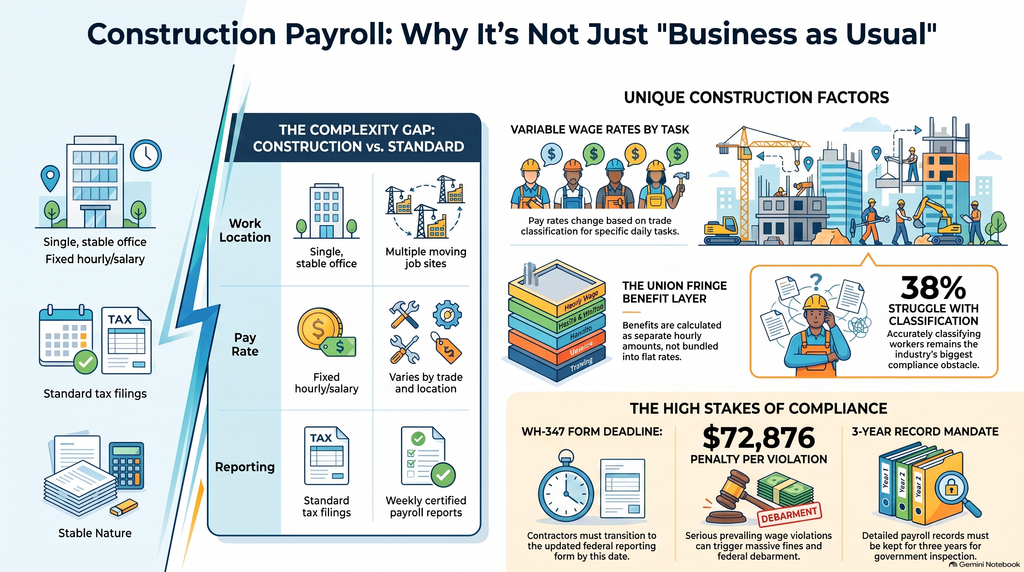
A single employee might work three different job sites in one week, each billed to a different project and cost code, and their pay rate can change depending on the trade classification for that specific task — a laborer doing electrical prep work on one day and general labor the next may legally be paid two different rates for those two days.
That single complication cascades into everything downstream: job costing reports, tax withholding by work location, and — on public projects — mandatory wage reporting to the government. Multiply it by a crew of 20 people moving across five active jobs, and it's clear why generic payroll software built for a single-location office often breaks down in construction.
Certified Payroll: The Compliance Core
Certified payroll is where construction payroll gets legally serious. On most federally funded construction projects, the Davis-Bacon Act requires contractors to document that they're paying the prevailing wage — the government-mandated minimum pay rate for that specific type of work in that specific location, not just federal minimum wage.
This isn't a paperwork formality with soft consequences. Falsifying certified payroll is a federal crime, and a prevailing wage violation on a government contract can result in debarment from federally funded work for up to three years.
The Department of Labor's Wage and Hour Division recovered over $274 million for workers in fiscal year 2024 alone, with construction accounting for a substantial share of that enforcement activity.
A time-sensitive detail worth knowing now: the certified payroll reporting form (WH-347) was updated effective January 6, 2025, adding enhanced fringe benefit reporting and new employee classification fields.
The old version of the form remains accepted only until September 30, 2026 — after that, contractors on federally funded projects need to be using the updated format.
Federal penalties for violations also rose 2.6% that same January under the Federal Civil Penalties Inflation Adjustment Act, with fines for serious violations potentially reaching $72,876.
Recordkeeping requirements underneath certified payroll are specific and non-negotiable. Contractors must maintain, for a minimum of three years, records for each employee including full name, address, Social Security number, work classification, hourly wage rate, daily and weekly hours worked, deductions, and actual wages paid — available for inspection by government officials on request.
The Multi-State Problem
Construction crews increasingly cross state lines within the same project or across simultaneous projects, and payroll compliance doesn't average out across states — it stacks. Nine states have implemented their own electronic certified payroll filing mandates on top of federal requirements, each with its own submission process and format.
Local law can add another layer entirely: in New York, for example, Real Property Tax Law § 485-x recordkeeping failures can trigger a 25% civil penalty on any calculated underpayment, plus an automatic $500 fine for every day the record failure continues.
The practical implication: a contractor working across three states isn't managing "construction payroll" once — they're managing it three separate ways simultaneously, each with independent filing deadlines, forms, and penalty structures.
Union Fringe Benefits: The Calculation Layer Most Systems Miss
For unionized crews, pay isn't just an hourly rate — it includes fringe benefits (health insurance, pension contributions, training fund payments) that are often calculated as a separate dollar amount per hour worked, on top of base wage.
On certified payroll reports, fringe contributions have to be broken out and documented distinctly from wages, not bundled into a single number.
This is one of the most commonly cited pain points among construction payroll professionals, and it's a major reason generic, non-construction payroll platforms tend to require manual workarounds — they're not built to separate and report fringe benefit data the way prevailing wage compliance demands.
Where Contractors Actually Get This Wrong
Industry survey data points to two dominant failure points. Roughly 27% of construction payroll professionals identify prevailing wage and certified payroll compliance as the single most complex part of their job, and worker classification is cited as a significant compliance obstacle by nearly 38% of them.
Classification errors — treating someone as a general laborer when their actual task falls under a higher-paid trade classification, or misclassifying a W-2 employee as a 1099 subcontractor — are among the most common and most penalized mistakes in this category.
Common Construction Payroll Mistakes to Avoid
- Treating certified payroll as a once-and-done setup rather than an ongoing weekly reporting obligation with its own deadlines.
- Using a payroll system not built for prevailing wage work, forcing manual reconciliation between time tracking, job costing, and compliance reporting — which is where errors creep in.
- Bundling fringe benefits into a flat hourly rate instead of reporting them as a distinct, documented line item.
- Missing the WH-347 form transition deadline of September 30, 2026, for contractors still using the outdated version.
- Underestimating multi-state stacking by applying one state's compliance process to a crew working across several.
FAQ
What's the difference between construction payroll and certified payroll? Construction payroll is the broader process of paying a mobile, multi-site workforce with variable wage classifications. Certified payroll is a specific legal reporting requirement that applies to federally (and often state) funded projects, documenting that prevailing wage rules under the Davis-Bacon Act are being followed.
Do all construction companies need certified payroll? No. Certified payroll only applies to contractors working on federally funded or state-funded public projects subject to prevailing wage laws. Private commercial or residential construction generally doesn't require it, though standard payroll complexity around job costing and multi-site work still applies.
What happens if certified payroll is filed incorrectly? Consequences range from withheld payments and audits to, in serious cases, federal criminal charges for falsification and debarment from federally funded work for up to three years. State-level penalties can add further fines on top of federal consequences.
How long do construction payroll records need to be kept? A minimum of three years, covering detailed records for each employee — including classification, hourly wage, hours worked, deductions, and actual wages paid — available for government inspection on request.
Is regular payroll software enough for a construction company? It depends on whether the company works on prevailing wage or multi-state projects. For purely private, single-state work, standard payroll software with job costing add-ons may be sufficient. For any federally or state-funded work, purpose-built construction payroll software or a certified payroll service is generally necessary to manage the reporting burden accurately.