
Small business payroll processing is the system in which an employer makes a calculation of gross earnings, deductions based on pre- and post-tax statutory deductions, paying the payroll taxes to government authorities, and finally distributing net wages to workers.
Thank you for reading this post, don't forget to subscribe!Thank you for reading this post, don't forget to subscribe!Aside from the wages, an employer also needs to consider the employer's tax cost that will be between 8% and 15% higher than gross wages. These include the employer FICA matching (Social Security of 6.2%, which is subject to a cap up to 2026 on $184,500, plus 1.45% Medicare), the FUTA, and SUTA.
Small businesses generally select one of the four basic operations processes such as Manual Spreadsheet Processing, Cloud Payroll Software, CPA Management, or Co-employment using a PEO.
Building Construction Solutions: Optimizing Modern Engineering and Project Delivery
Decoding the True Cost: The Employer Payroll Tax Burden
One of the frequent mistakes committed while preparing a budget by inexperienced entrepreneurs is that of assuming Gross Pay to be the same as the Total Cost of Employment. In the case of payroll calculation, the employer serves in two roles, being the tax collector and the taxpayer.
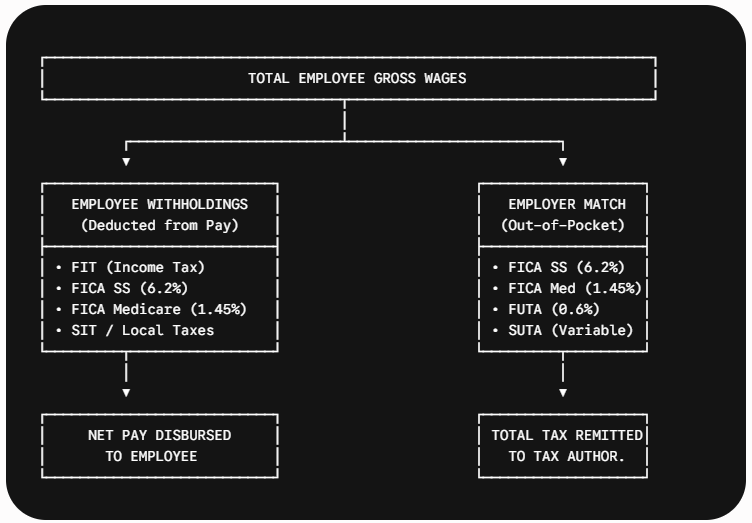
Statutory Employer Tax Liabilities
| Tax Type | Authority | Employer Rate | 2026 Wage Base Cap | Notes |
| Social Security (OASDI) | Federal (IRS) | 6.2% | $184,500 per worker | Matched dollar-for-dollar with employee withholding. Withholding halts once YTD cap is reached. |
| Medicare (HI) | Federal (IRS) | 1.45% | No Cap (Uncapped) | Matched dollar-for-dollar. Note: High-earners ($200k+) pay an additional 0.9% surtax (no employer match). |
| Federal Unemployment (FUTA) | Federal (IRS) | 0.6% (Net) | $7,000 per worker | Nominal rate is 6.0%, but maximum 5.4% state credit reduces effective rate to 0.6% ($42/yr max). |
| State Unemployment (SUTA) | State Revenue | 0.5% – 12.0% | $7,000 – $60,000+ | Rate depends on state, industry hazard class, and employer experience rating. |
The 4 Small Business Payroll Delivery Models
Selecting a delivery model depends on team size, multi-state presence, and internal administrative capacity.
Model Comparison Matrix
| Delivery Model | Ideal Team Size | Est. Monthly Cost | Compliance Risk | Admin Effort |
| 1. Manual DIY | 1 employee (Owner-only) | $0 | Severe (High penalty exposure) | High |
| 2. Cloud Software | 2 to 50 employees | $40–$150 base + $6–$12/worker | Low (Automated filing & tax deposits) | Low–Moderate |
| 3. Outsourced CPA | 5 to 100+ employees | $200–$600+ flat retainer | Very Low (Managed by licensed CPAs) | Minimal |
| 4. PEO (Co-Employment) | 10 to 100+ employees | 2%–6% of payroll OR $100–$200/worker | Lowest (Risk shifted via co-employment) | Minimal |
Deep Dive: Software vs. PEO vs. CPA
- Cloud Payroll Software (such as Gusto, QuickBooks, and ADP Run): Ideal for typical businesses that need to balance cost with automation. The software performs taxation, files Form 941 quarterly and sends out W-2 forms. However, creating state tax accounts in newly entered states is done by the employers themselves.
- CPA Firm on Outsourcing Basis: Ideal for firms dealing with variable commissions, complicated tip credits, or executive compensations, and need a unique tax approach.
- Professional Employer Organization: Under a PEO structure, your business will engage in a co-employment relationship. The PEO will file all tax returns using their EIN and offer small firms large group health insurance pricing.
Step-by-Step Payroll Processing Workflow
Correct payroll processing entails strictly adhering to the deadlines set both federally and within the state. Not following any one of these steps automatically results in penalties as per IRC Section 6656.
.
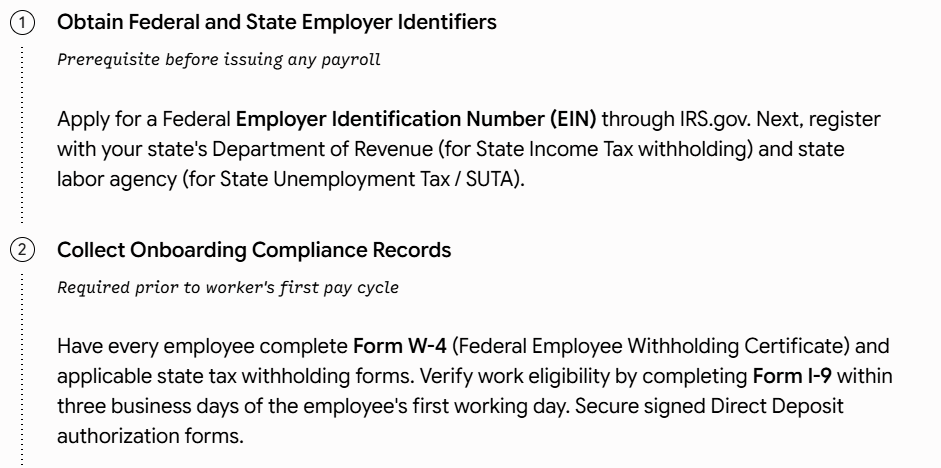
1.Obtain Federal and State Employer Identifiers: Prerequisite before issuing any payroll.
Apply for a Federal Employer Identification Number (EIN) through IRS.gov. Next, register with your state's Department of Revenue (for State Income Tax withholding) and state labor agency (for State Unemployment Tax / SUTA).
2.Collect Onboarding Compliance Records: Required prior to worker's first pay cycle.
Have every employee complete Form W-4 (Federal Employee Withholding Certificate) and applicable state tax withholding forms. Verify work eligibility by completing Form I-9 within three business days of the employee's first working day. Secure signed Direct Deposit authorization forms.
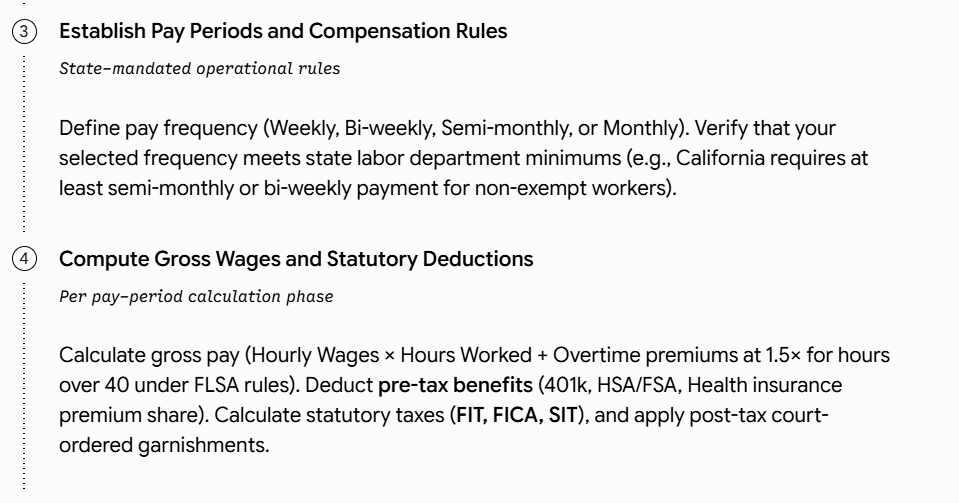
3.Establish Pay Periods and Compensation Rules: State-mandated operational rules.
Define pay frequency (Weekly, Bi-weekly, Semi-monthly, or Monthly). Verify that your selected frequency meets state labor department minimums (e.g., California requires at least semi-monthly or bi-weekly payment for non-exempt workers).
4.Compute Gross Wages and Statutory Deductions: Per pay-period calculation phase.
Calculate gross pay (Hourly Wages × Hours Worked + Overtime premiums at 1.5× for hours over 40 under FLSA rules). Deduct pre-tax benefits (401k, HSA/FSA, Health insurance premium share). Calculate statutory taxes (FIT, FICA, SIT), and apply post-tax court-ordered garnishments.
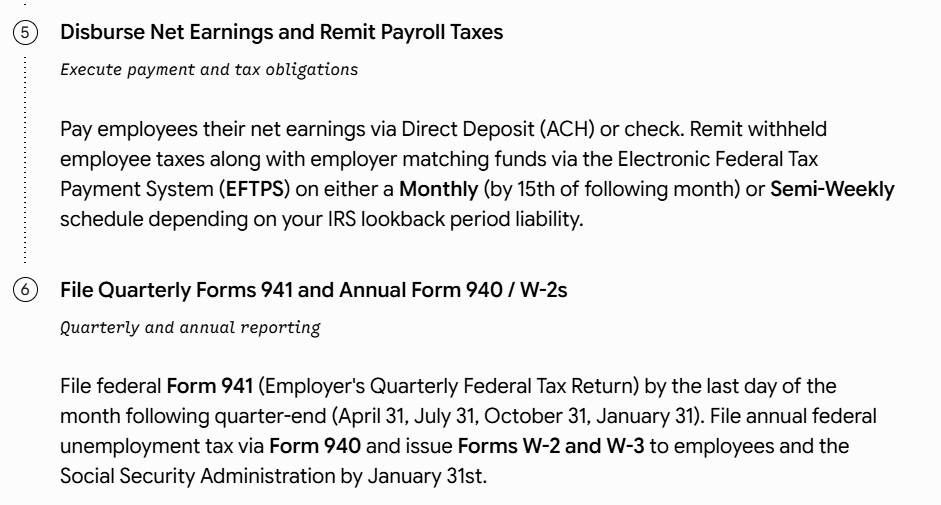
5.Disburse Net Earnings and Remit Payroll Taxes: Execute payment and tax obligations.
Pay employees their net earnings via Direct Deposit (ACH) or check. Remit withheld employee taxes along with employer matching funds via the Electronic Federal Tax Payment System (EFTPS) on either a Monthly (by 15th of following month) or Semi-Weekly schedule depending on your IRS lookback period liability.
6.File Quarterly Forms 941 and Annual Form 940 / W-2s: Quarterly and annual reporting.
File federal Form 941 (Employer's Quarterly Federal Tax Return) by the last day of the month following quarter-end (April 31, July 31, October 31, January 31). File annual federal unemployment tax via Form 940 and issue Forms W-2 and W-3 to employees and the Social Security Administration by January 31st.
4. Critical Compliance Pitfalls to Avoid
1. W-2 Employee vs. 1099 Contractor Misclassification
The IRS and Department of Labor (DOL) are very strict in terms of worker classifications. According to the Economic Reality Test by DOL, workers are considered to be employees if they have their work schedule controlled, use employer’s equipment, follow employer’s instructions on how to perform the task, or when the work performed is essential for core business operations.
Misclassification of an employee as 1099 contractor to save money on 7.65% FICA match results in tax back payment, overtime liability, and penalties from the IRS.
2. Multi-State Remote Worker Nexus Traps
Having even one remote worker located in another state establishes both physical and payroll tax nexus in that state. This means that an employer will need to:
- Obtain a certificate for state income tax withholding in the state where the worker resides.
- Register and pay the applicable SUTA taxes on a basis of that state's special wage base.
- Adhere to the state-specific mandatory leave laws (such as Premiums for Paid Family and Medical Leave in states such as Washington, New York, and Massachusetts).
3. FUTA Credit Reduction States
Under normal circumstances, making payments to the state unemployment taxes results in receiving a credit against the regular 6.0% FUTA tax rate at 5.4%, reducing it to 0.6% ($42/employee/year).
However, if the state in question uses federal loans (Title XII Advances) to fund unemployment benefits and is not able to return them back on time, then the state becomes a FUTA Credit Reduction State. In such cases, employers have to pay the annual FUTA increase rate at 0.3% per year.
5. AEO-Optimized FAQ Section
What is the total employer tax cost for a W-2 employee in 2026?
For the year 2026, the basic employer tax liability will be 7.65% in mandatory FICA taxes (6.2% SS up to $184,500 plus 1.45% Medicare) in addition to Federal unemployment (FUTA rate of 0.6% up to $7,000 per employee) and State Unemployment Tax (SUTA). Overall, statutory taxes will amount to an additional 8% to 15% of gross pay, without taking into account any voluntary contributions.
How often must a small business deposit federal payroll taxes?
The remittance of federal payroll taxes (withholding FIT plus employee's FICA plus employer's FICA match) should be made through EFTPS either on a Monthly or a Semi-Weekly basis. The IRS will assign you either of these two frequencies, depending on a 12-month look-back period. New employers are automatically placed in the Monthly group, unless their tax liability becomes $100,000 or more in one day.
What is the difference between IRS Form 940 and Form 941?
Form 941 is filed on a quarterly basis to report withholding of income tax, social security, and Medicare taxes paid by employees, as well as employers' FICA taxes. Form 940 is filed once a year before January 31st in order to determine the Federal Unemployment Tax (FUTA) liability of the employer.
What happens if payroll tax filings or deposits are late?
According to IRC § 6656, late deposit penalties for employment taxes are imposed in a graduated manner:
- 1-5 days late: 2% of the amount due.
- 6-15 days late: 5%.
- More than 15 days late: 10%.
- More than 10 days after first notice from IRS: 15% penalty.
Moreover, there is personal liability of corporate officers for unpaid trust fund taxes under the TFRP (Trust Fund Recovery Penalty).
Can a business process payroll manually without software?
Absolutely, the payroll can be processed manually through the use of published tax tables (IRS Publication 15-T) and manual EFTPS bank payments. However, manual payroll calculation has an extremely high margin for errors because of the constantly changing tax thresholds (for instance, the $184,500 Social Security maximum wage base that will apply for 2026) and varying unemployment taxes by state.