
Prevailing Wage and Davis-Bacon Act Compliance: Compliance with prevailing wage law and the Davis-Bacon Act means that contractors and subcontractors performing construction work on government-funded or government-assisted construction projects shall pay no less than the locally prevailing rate of wages and fringe benefits for the occupation for workers within the area where the construction work will take place.
Thank you for reading this post, don't forget to subscribe!Thank you for reading this post, don't forget to subscribe!This act is applicable to all government construction contracts over $2,000 for construction, alteration, and repair of public buildings and works, while compliance requires certain actions, such as receiving the appropriate wage determination for the specific geographic area and occupation, paying workers based on those rates, and submitting certified payroll records (usually on form WH-347).
In addition to the above actions, contractors need to accurately classify workers, record time and payrolls and make sure that fringe benefits are either paid directly or provided through a bona fide fringe benefit plan. Failure to comply with the Davis-Bacon Act may result in penalties, withholding of payment and other negative consequences, which is why many construction companies resort to using payroll software.
Executive Summary: Dealing with prevailing wages is no longer something that must be considered exclusively by big players involved in federal infrastructure building projects. Due to federal infrastructure funds, tax credits for clean energy, as well as new Department of Labor (DOL) regulations, the list of construction projects that fall under prevailing wages requirements has become longer. This guide is designed to provide you with the knowledge you need in order to stay compliant and profitable.
Prevailing Wage & Davis-Bacon Act 101
Before complying with commercial and civil projects, construction companies have to know the primary laws concerning prevailing wages.
The Davis-Bacon Act (DBA) & Davis-Bacon and Related Acts (DBRA)
- Davis-Bacon Act (DBA): Adopted in 1931, the DBA requires contractors and subcontractors to pay locally prevailing wages and benefits to laborers and mechanics employed on federal contracts for construction work in excess of $2,000.
- Davis-Bacon and Related Acts (DBRA): More than 70 laws provide that the Davis-Bacon standards apply to non-federal construction projects financed or assisted with federal funding (i.e., construction of highways, housing for low-income persons, clean-water facilities).
What Is a "Prevailing Wage"?
Prevailing wage is not simply a pay rate per hour. It is a combination of two different figures set forth in a federal Wage Determination:

| Component | Description | Examples |
| Basic Hourly Rate | The minimum monetary wage paid directly to the employee per hour worked on site. | $38.50 / hour |
| Fringe Benefit Rate | An additional amount paid per hour into bona fide benefit plans or cash equivalents. | $14.20 / hour |
| Total Required Rate | The combined total required by law for every covered hour worked. | $52.70 / hour |
Key Regulatory Framework: The Modern 30% Rule
The Department of Labor's reforms to the rules for implementing the Davis-Bacon and Related Acts completely transformed the way in which prevailing wages are determined and enforced.
Back to the "30% Rule"
Until recent changes in the rules, if the vast majority (>50%) of the workers in a certain trade and county earned different wages, the DOL would determine the prevailing wage based on a weighted average wage. Today, the process works as follows:
- Majority Rate (>50%): If more than 50% of the workers in a trade get paid the same wage, then it will be used as the prevailing wage.
- 30% Threshold: If there is no majority rate, the prevailing wage will be equal to the wage of the largest number of workers, as long as this wage is paid to at least 30% of workers in the particular classification.
- Weighted Average: If there is no rate that is paid to at least 30% of the workers, then only a weighted average applies.
Effect: Returning to the 30% rule increases the chances that union scale or established market wages become the prevailing wages.
Periodic Wage Rate Adjustments
Periodic Adjustments of Wages Rates
In order to avoid having non-union prevailing wages rate being stale for years in between surveys of prevailing wage rates, the DOL is periodically adjusting the prevailing wage rates through Employment Cost Index (ECI).
Increased Record-Keeping and Enforcing Measures
- The 3-Year After-Completion Requirement: All contracts, payroll documents, and certifications must be maintained by contractors for at least 3 years after completion of the construction project.
- Cross-Withholdings: The contracting agency may hold back the accrued payments under several federal contracts from the same contractor in order to cover the unpaid wages.
- Prohibitions on Retaliation: Clear prohibitions exist protecting the workers from retaliation due to their questions about accuracy of pay or reporting of violations.
Infrastructure Financing and Tax Credit Implications
The combination of federal infrastructure financing and legislation on clean energy has increased the scope of prevailing wage requirements to cover projects that traditionally have been beyond federal jurisdiction.
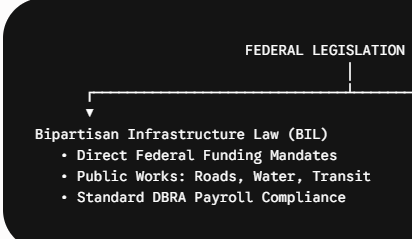
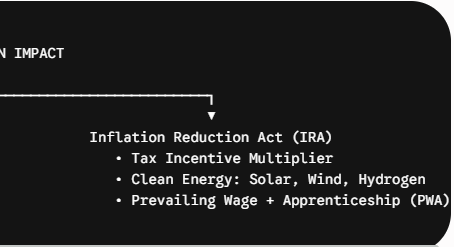
The Bipartisan Infrastructure Law (BIL / IIJA)
The Infrastructure Investment and Jobs Act pumped hundreds of billions of dollars into State Departments of Transportation, municipalities, and utilities. Major projects falling under the DBRA guidelines include:
- Transport, highways, and bridges;
- Public transport and railway extensions;
- Clean water supply, wastewater, and dams repairs;
- Broadband networks and EV chargers installation.
The Inflation Reduction Act (IRA): The 5x Tax Credit Multiplier
Unlike regular federal grants for which Davis-Bacon is a requirement in a contract, the IRA operates using the tax credit incentive system. For those who develop renewable energy infrastructure, i.e., build solar farms, carbon capture, clean hydrogen, and energy storage facilities, a 5x multiplier for tax credits can be received (for example, from 6% to 30%) provided that two fundamental requirements are met:
- Prevailing Wage Rate: Providing local prevailing wage rates for all laborers and mechanics while constructing and for the required period of post-construction alterations and repairs.
- Registered Apprenticeship Requirements (PWA): Having not less than 15% of total hours of construction done by apprentices engaged in DOL-registered programs.
Master Certified Payroll & Form WH-347 Compliance
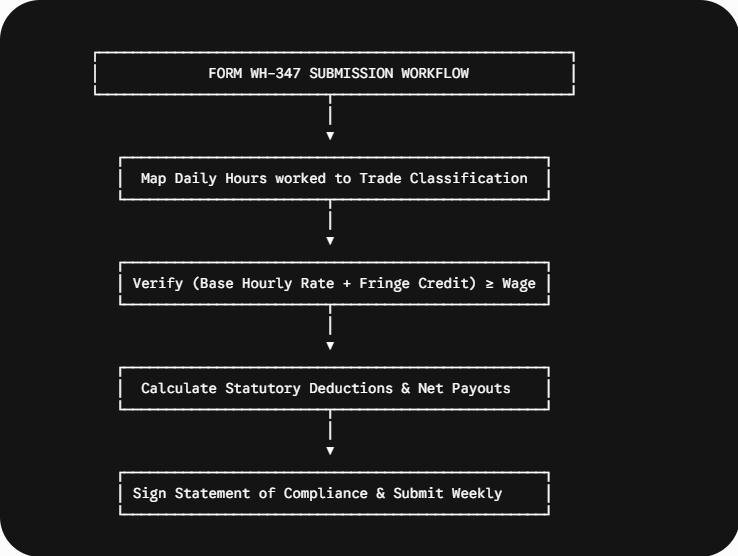
For contractors to show proof of compliance for DBRA and prevailing wage projects, they are required to file weekly certified payroll forms, either through U.S. Department of Labor form WH-347 or state-specific online filing systems (for instance, LCPtracker, Elation Systems, California DIR).
Understanding Form WH-347
Each week, the contractor is required to provide:
- Payroll Data Sheet: Details including the name of each employee, their job classification, hours of work daily/weekly, pay rate, total pay, deduction and net pay.
- Statement of Compliance: Signed declaration from the contractor or an authorized agent swearing under the penalty of perjury that the payroll data are accurate, complete and wage paid meet the requirements of the Wage Determination.
Handling Fringe Benefits: Cash vs. Plans
Contractors must pay the full fringe benefit rate through any of the following three options:
- Bona Fide Fringe Benefit Contributions: Making direct contributions towards approved fringe benefit programs such as health/dental insurance, 401K programs, or apprenticeship training programs.
- Cash in Lieu of Fringes: Adding the fringe rate required for each hour to the employee's regular wages. (Note: Payout of fringe in cash is subject to payroll taxes.)
- Any Combination of Both: A certain percentage can be contributed towards bona fide fringe benefit premiums, and the rest can be paid in cash.
Top 4 Prevailing Wage Pitfalls to Avoid
- Misclassification of Trades: Using a higher level skilled laborer at a lower rate classification (for example, assigning a worker who is doing framing structure to be classified under the name General Laborer instead of Carpenter). The workers have to be paid according to the work done physically each day.
- Unregistered Apprentices: Payment to an employee as an apprentice wage rate without his registration in a federal or state apprenticeship program. Unregistered apprentices need to be paid the full journeyman prevailing wage rate.
- Inadequate Supervision Ratio Exceeds: Violating the stringent ratio rules of supervision (for example, 1 journeyman to 1 apprentice) provided in the agreement of registered apprenticeship. Any overtime performed in violation of ratios should be compensated according to journeyman rates.
- Recording Off-Site and On-Site Time: Not recording the amount of time devoted to transporting trucks, materials, or even working in a dedicated off-site yard for fabrication for the particular jobsite.
How Construction Payroll Technology Streamlines Compliance
Traditional spreadsheet-based management of prevailing wages exposes construction companies to heavy penalties from audits, project delays, and even debarments.
Construction payroll software overcomes these compliance hurdles through:
- Automatic Rate Lock-In & Overrides: Assigning the right rate based on the location of the job site, union agreements, or contract details of the project.
- Multi-Trade Job Tracking: Enabling field managers to record split shifts such that individuals who work in several trades within one day get the correct rate for the corresponding hours.
- Automatic Calculation of Bonafide Fringe Credits: Subtracting bonafide fringe credits from payrolls to reduce taxes payable but still meet the wage threshold.
- Pre-filled WH-347 Reporting: Generating the certified payroll reports in either WH-347 PDF or uploading data directly into federal/state/external certified payroll applications in XML format.
Key Takeaways
- Prevailing Wage goes beyond Federal Jobs: The IRA and BIL initiatives provide tax incentives and infrastructure projects for commercial and renewable energy markets that fall under prevailing wage rules.
- Compliance demands rate calculation accuracy: Contractors must ensure that the total amount of the employee’s hourly rate plus bonafide fringes is higher than the prevailing Wage Determination rate for all hours worked.
- Correct reporting avoids serious consequences: Compliance with weekly WH-347 reports demands strict attention to job classification, ratio apprenticeship program compliance, and off-site time tracking.